The Ultimate Guide to Watch Winders for Automatic Watches
A watch winder keeps an automatic watch moving when it is not being worn, but choosing the right one involves more than selecting a rotating box. This guide explains how watch winders work, TPD and rotation settings, motor noise, capacity and storage design, as well as when a secure watch winder safe may be a better choice for valuable watch collections.
A watch winder looks simple from the outside.Put the watch on a holder, switch the unit on, and the watch begins to rotate.That basic description, however, leaves out most of what actually matters.Different automatic watches have different winding requirements. Some movements wind in both directions, while others respond more effectively to clockwise or counterclockwise rotation. Some collectors need only one or two winding positions.
Others have six, ten or more watches and want one secure place for winding, jewelry storage and daily organization.There is also a practical question that comes up surprisingly often:
Does an automatic watch really need a watch winder?
The answer is not always yes.A good watch winder is mainly about convenience, correct movement support and organized storage. For valuable collections, it can also become part of a broader security solution.This guide explains what matters before you choose one.
What Is a Watch Winder?
A watch winder is a motorized device designed to rotate an automatic mechanical watch while the watch is not being worn.
An automatic watch normally winds itself through the movement of the wearer's wrist. Inside the watch, a rotor moves as the wrist changes position. That motion helps wind the mainspring and maintain the watch's power reserve.
When the watch is left unused for long enough, the stored energy eventually runs down.The watch stops.That is not necessarily a problem. Most automatic watches can simply be wound and reset when the owner wants to wear them again.For some watches, though, restarting them is inconvenient.
A simple three-hand automatic watch may take only a minute to reset. A watch with a date, day, moon phase, annual calendar or other complication may take considerably longer.This is where a watch winder becomes useful.By rotating the watch at programmed intervals, it helps keep the movement running and reduces the need for frequent resetting.
How Does an Automatic Watch Stay Wound?
To understand a watch winder, it helps to understand the watch itself.Automatic watches are mechanical watches with a self-winding system.Inside the movement is a weighted rotor. As the wearer moves, the rotor turns and transfers energy into the winding mechanism.
That energy is stored in the mainspring.Once the mainspring has enough stored energy, the watch can continue running even after it is removed from the wrist.This operating time is usually referred to as the power reserve.Different watches have different power reserves.
Some may run for around a day or two. Others are designed to operate much longer before stopping.If a watch is worn regularly, this is usually not something the owner needs to think about very much.If the watch is part of a larger collection and may sit unused for several days, the situation changes.A watch winder essentially imitates part of the wrist movement the watch would normally experience.
Do Automatic Watches Really Need a Watch Winder?
Not every automatic watch needs one.That point is worth stating clearly.If you own one automatic watch and wear it every day, a winder may add little practical benefit.If you own several watches and rotate between them, the answer may be different.
A watch winder is particularly useful when:
- You own several automatic watches
- Some watches are worn only occasionally
- You want to avoid resetting the date repeatedly
- Your watch has complications that take time to adjust
- You want a dedicated storage location
- You prefer your collection to remain ready to wear
- You want winding and secure storage in one system
Collectors often value convenience more than anything else.A stopped watch is not automatically a damaged watch.The issue is simply whether the owner wants to reset it every time.
Are Watch Winders Good for Automatic Watches?
A properly designed and correctly configured watch winder can be suitable for automatic watches.The important words are properly configured.A watch should not simply be placed on an unknown setting and left rotating continuously.
A good winder allows the owner to control or select:
- Turns per day
- Rotation direction
- Operating intervals
- Rest periods
- Individual winding positions
The exact winding requirement depends on the movement.This is why it is better to follow the watch manufacturer's guidance when possible rather than assuming every automatic movement needs the same setting.
What Does TPD Mean on a Watch Winder?
TPD means Turns Per Day.It is one of the most important specifications to understand when choosing a watch winder.TPD describes the approximate number of rotations the winder will perform during a day.
For example, a winder may offer settings such as:
- 650 TPD
- 750 TPD
- 850 TPD
- 1,000 TPD
These are only examples. Actual available programs vary by product.The correct TPD depends on the watch movement.Some watches require relatively low daily rotation. Others may need more.The goal is not to use the highest setting available.The goal is to provide enough movement to maintain the watch's charge without unnecessary continuous operation.
How Do You Choose the Right Watch Winder TPD Setting?
The safest approach is to check the specifications of the watch movement.If the watch manufacturer provides winding guidance, use that as the starting point.When the information is not immediately available, the movement model can often help determine the appropriate setting.A lower suitable setting is generally more sensible than selecting maximum rotation simply because the option exists.
For collectors with several watches, individually controlled winding positions are useful because different watches may require different programs.One watch may need one TPD setting while another requires a different direction or rotation frequency.This matters much more in a multi-watch collection than in a single-watch setup.
Clockwise, Counterclockwise or Bidirectional Rotation?
Rotation direction is another important setting.Watch winders generally use one or more of the following modes:
Clockwise
The watch rotates in one direction only.
Counterclockwise
The watch rotates in the opposite direction.
Bidirectional
The winder alternates between clockwise and counterclockwise movement.Not every automatic movement winds equally well in both directions.Some movements are bidirectional. Others may wind more effectively in one direction.
This is why a programmable automatic watch winder is usually more flexible than a basic unit with one fixed rotation mode.For a collector with watches from different movement families, independent winding controls can become particularly valuable.
Can a Watch Winder Overwind an Automatic Watch?
This is a common concern.Modern automatic watches are generally designed with mechanisms that help prevent the mainspring from being wound indefinitely in the same way as a simple manual-wind spring.
Even so, that does not mean more winding is always better.Excessive rotation is unnecessary.A watch winder should imitate normal use, not keep the watch spinning constantly.Well-designed winders therefore use programmed rotation cycles and rest periods.The main objective should be maintaining the watch within an appropriate winding range, rather than maximizing the number of rotations.
Can a Watch Winder Damage a Watch?
A suitable winder used with appropriate settings should not be treated as inherently harmful to an automatic watch.Problems are more likely to come from poor product design or inappropriate settings.
Examples include:
- Excessive rotation
- Incorrect TPD
- Wrong winding direction
- Poor-quality watch holders
- Excessive vibration
- Unstable motor operation
- A holder that puts too much pressure on the bracelet
- Poor interior materials that may scratch the watch
This is why the winding mechanism is only one part of the product.The holder, motor, interior finish and program control all matter.
Why Motor Quality Matters
A watch winder is often placed in a bedroom, dressing room, wardrobe or study.Noise therefore matters more than many buyers expect.A loud motor may seem acceptable in a showroom or product test.It becomes far more irritating at night.A silent watch winder should use a motor system designed for smooth, low-noise operation.
For bedroom use, buyers should pay attention to:
- Motor noise
- Mechanical vibration
- Sudden start-stop movement
- Drawer or enclosure resonance
A high-end enclosure can actually amplify a poor motor if the internal structure is not designed carefully.For this reason, motor quality and enclosure design should be considered together.
What Makes a Good Watch Holder?
The holder is another component that is easy to overlook.A good holder needs to keep the watch stable without putting excessive pressure on the strap or bracelet.It should also accommodate different wrist sizes.For a mixed collection, flexibility matters.A large sports watch may sit very differently from a smaller dress watch.
Collectors should look for holders that:
- Support the watch securely
- Do not scratch the case or bracelet
- Fit different watch sizes
- Keep the watch centered during rotation
- Are easy to remove and reinstall
For luxury watches, the surface material of the holder is also important.Soft-touch materials, microfiber or leather-like finishes are often preferred over hard exposed plastic.
Single Watch Winder or Multi Watch Winder?
This depends mainly on the collection.A single watch winder is suitable for someone who owns one automatic watch or wants a compact bedside solution.A dual model works well for a small rotating collection.Once the number of watches increases, a multi-position winder becomes more practical.
| Collection Size | Suitable Winder Type |
| 1 automatic watch | Single watch winder |
| 2 watches | Dual watch winder |
| 3–4 watches | Multi-position winder |
| 5–8 watches | Multi watch winder cabinet |
| Large valuable collection | Watch winder safe |
The last category is important.Once the collection becomes valuable enough, winding is no longer the only concern.Security becomes part of the decision.
Watch Winder vs Watch Box
A watch box and a watch winder serve different purposes.A watch box provides organized storage.A watch winder adds movement.For quartz watches, manual-wind watches or watches that are rarely worn, a conventional watch box may be completely adequate.For automatic watches that the owner wants to keep running, a winder adds convenience.Some collectors use both.
Others prefer an integrated product that combines:
- Automatic winding
- Watch storage
- Jewelry organization
- Secure locking
- Furniture integration
This is where the watch winder safe becomes relevant.
When Should You Consider a Watch Winder Safe?
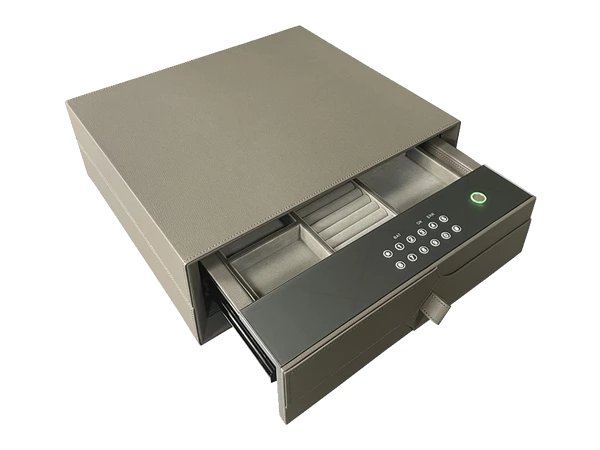
A standard watch winder focuses on movement.A watch winder safe combines winding with secure storage.That distinction becomes more important as the value of the collection grows.Someone with one everyday automatic watch may not need a safe.Someone storing several high-value watches, jewelry, passports and other valuables may prefer a more secure solution.
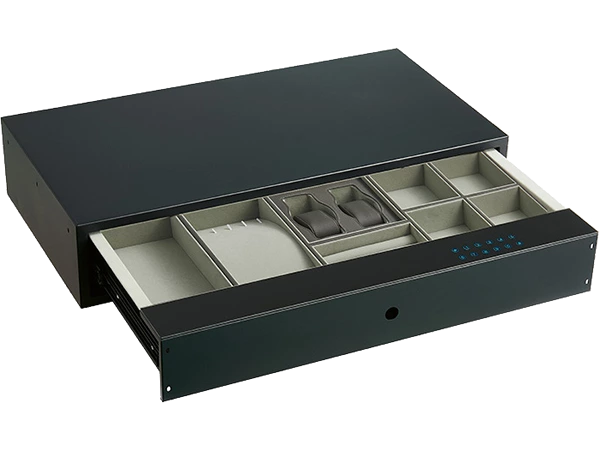
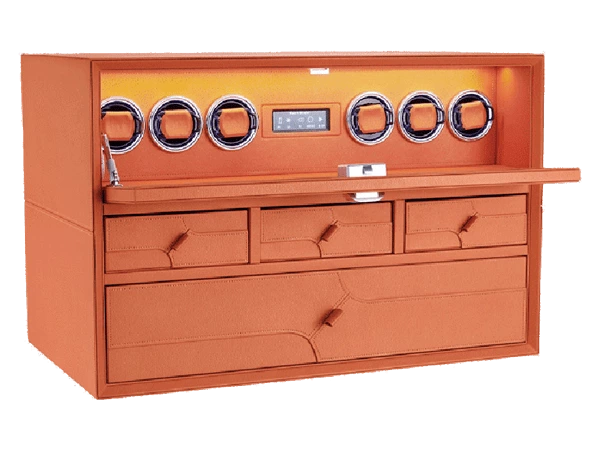
A watch winder safe can integrate:
- Automatic winding positions
- Fingerprint access
- Digital password access
- Steel safe body
- Jewelry compartments
- Watch storage
- Interior lighting
- Leather or microfiber trim
- Drawer storage
- Custom furniture installation
The best products treat these functions as one system rather than simply placing a motor inside a safe.
Watch Winder vs Watch Winder Safe
| Feature | Standard Watch Winder | Watch Winder Safe |
| Keeps automatic watches wound | Yes | Yes |
| TPD control | Available on better models | Available |
| Rotation direction | Available on programmable models | Available |
| Security protection | Limited | Stronger |
| Fingerprint access | Usually no | Available |
| Password access | Usually no | Available |
| Jewelry storage | Limited | Available |
| Steel security body | No | Yes |
| Furniture integration | Limited | Available |
| Best for | Everyday winding | Valuable watch collections |
For collectors, the choice depends on what they are trying to protect.If the main priority is simply keeping a watch running, a standard winder may be enough.If the watches themselves represent significant value, security deserves equal attention.
How Should Luxury Watches Be Stored?
Luxury watch storage is not only about preventing theft.Good storage should also protect the watches physically.That means avoiding unnecessary contact between watches, bracelets and jewelry.
A well-designed storage system can include:
- Individual watch positions
- Soft-lined trays
- Ring compartments
- Bracelet sections
- Open accessory storage
- Watch pillows
- Separate jewelry sections
A watch should not need to share one unprotected compartment with keys, cufflinks or metal jewelry.For this reason, divided interiors are valuable even before security is considered.
Why Jewelry Compartments Matter in a Watch Safe
Many watch collectors also own jewelry.
It is common for a safe to store:
- Watches
- Rings
- Bracelets
- Necklaces
- Cufflinks
- Cash
- Passports
- Small documents
A completely open interior is flexible, but not always convenient.Divided jewelry sections make daily use much easier.The user can open the safe and immediately see where each item belongs.For premium residential use, this organization often matters as much as the lock system.
What Is a Smart Watch Winder Safe?
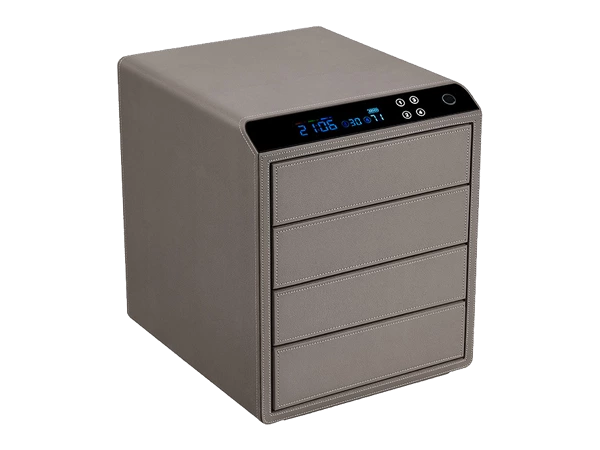
A smart watch winder safe combines conventional security with electronic access and programmable watch winding.
Depending on the model, the control system may include:
- Fingerprint recognition
- Digital password
- Touchscreen controls
- Electronic status display
- Individual winder settings
- Lighting control
The idea is not simply to add more technology.The technology should make the safe easier to use.A well-designed smart system should remain intuitive even when several functions are integrated into one product.
Fingerprint or Password Access: Which Is Better?
Both have advantages.
Fingerprint Access
Fingerprint access is convenient for private homes and personal dressing rooms.The owner can access the safe quickly without remembering or entering a code.
Password Access
Password access is flexible when several authorized users need access or when fingerprint enrollment is not appropriate.
Combined Access
For many premium residential safes, using both fingerprint and password options provides the greatest flexibility.The correct choice depends on the application.A private bedroom safe may have different access requirements from a hotel, showroom or shared residence.
Where Can a Watch Winder Safe Be Installed?
A watch winder safe does not have to stand alone.It can be integrated into furniture.
Common locations include:
Walk-In Wardrobe
This is one of the most natural applications.
Watches and jewelry are stored near clothing and dressing accessories.
Bedroom Cabinet
A cabinet can provide convenient but discreet access.
Dressing Room
Dedicated dressing furniture allows the safe to become part of the room design.
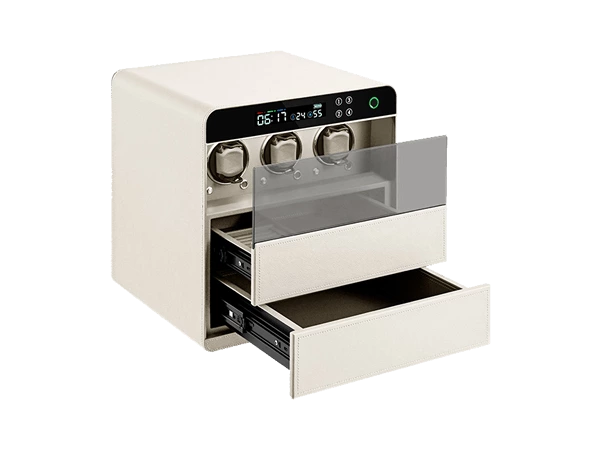
Bedside Furniture
Compact models can be suitable when the user wants selected valuables nearby.
Custom Wardrobe
A built-in installation gives designers more control over appearance and space use.
Luxury Hotel Suite
Premium hospitality projects may use integrated watch and jewelry safes as an upgrade from a conventional room safe.
Why Furniture Integration Matters
A high-value watch collection is often stored in a high-end interior.That creates a design challenge.A conventional industrial-looking safe may be secure, but it can feel visually disconnected from a luxury wardrobe.Furniture-integrated safes solve this by allowing the security product to work with the room rather than against it.
Possible finishes include:
- Leather
- Microfiber
- Wood-look panels
- Dark metal
- Coordinated drawer fronts
- Custom interior colors
The safe should still look secure.It simply does not need to look out of place.
How Do You Choose the Right Watch Winder Capacity?
Capacity should be based on both the current collection and realistic future use.Buying a 12-position winder for two watches may be unnecessary.Buying a two-position model for a rapidly growing collection can be equally frustrating.
Consider:
- Number of automatic watches
- Number of non-automatic watches
- Jewelry storage needs
- Future collection growth
- Available furniture space
- Whether individual TPD control is needed
For collectors with mixed watch types, not every watch needs to sit on a winder.Manual-wind and quartz watches can usually be stored in regular watch compartments.That allows the winder positions to be reserved for automatic models.
Should Every Watch Winder Position Have Independent Control?
For a mixed collection, this can be very useful.Different automatic watches may require different winding settings.If all winding positions operate with one fixed program, the collector loses flexibility.
Independent control allows:
- Different TPD settings
- Different rotation directions
- Different active positions
- Some positions to remain off
This becomes especially important in larger multi watch winder systems.A collector may own several watches from different movement families.One universal program may not be ideal for all of them.
What Should You Look for in a Luxury Watch Winder?
A luxury product should offer more than expensive materials.
Useful features include:
Programmable TPD
The winder should support appropriate daily rotation levels.
Multiple Rotation Directions
Clockwise, counterclockwise and bidirectional settings improve compatibility.
Low-Noise Motor
Important for bedrooms and quiet interiors.
Secure Watch Holders
The watch should remain stable during movement.
Quality Interior Materials
The surfaces touching the watch should feel soft and refined.
Reliable Control System
The interface should be easy to operate.
Appropriate Capacity
More positions are not automatically better.
Good Storage Layout
Jewelry and accessories should have their own sections.
For security-focused products, add:
Strong Safe Body
Fingerprint or Password Locking
Furniture Fixing Options
Controlled Access
Can Watch Winders Be Left Running All the Time?
A good watch winder does not need to rotate continuously.Most proper systems use operating cycles.The watch rotates for a period, then rests.This approach better reflects normal wrist use.Users should select an appropriate program rather than assuming continuous movement is desirable.If a watch will not be worn for a long time, some owners may also prefer to let it stop and store it safely instead.There is no requirement that every automatic watch remain running every day of the year.
How Long Should an Automatic Watch Stay in a Winder?
There is no universal number of hours that applies to every watch.The more useful question is whether the winder is delivering the required TPD and direction.A programmed winder may operate intermittently throughout the day rather than continuously for a fixed number of hours.
The exact setting should reflect:
- Movement design
- Required TPD
- Rotation direction
- Frequency of use
- Power reserve
This is another reason programmable control is more useful than a simple on/off motor.
What About Long-Term Watch Storage?
For long-term storage, winding is only one consideration.The environment also matters.
Collectors should pay attention to:
- Moisture
- Excessive heat
- Direct sunlight
- Dust
- Physical contact
- Security
- Battery condition in electronic storage equipment
For high-value watches, secure and organized storage may matter more than keeping every watch continuously wound.A watch collection should be treated as both mechanical equipment and a valuable personal asset.
When Does a Watch Collection Need More Security?
There is no fixed collection value at which someone must buy a safe.The decision is personal.
However, security becomes more relevant when:
- Several high-value watches are stored together
- Jewelry is stored with watches
- The collection is visible in a dressing room
- Multiple people have access to the property
- The owner travels frequently
- The collection is stored in a second home
- The watches are part of a private collection or inheritance
At that point, a display-only watch winder may no longer be enough.A secure watch safe with winders can combine convenience with controlled access.
Can a Watch Winder Safe Be Customized?
Yes.This is particularly important for collectors, furniture manufacturers, interior designers and hospitality projects.Depending on design feasibility and order requirements, a custom watch winder safe can include changes to:
| Customization Area | Typical Options |
| Number of winder positions | Single or multiple winding modules |
| Drawer layout | Watch, jewelry and accessory sections |
| TPD control | Adjustable programs |
| Rotation mode | Clockwise, counterclockwise, bidirectional |
| Lock system | Fingerprint, password or combined access |
| Exterior finish | Leather, microfiber or custom color |
| Interior finish | Coordinated tray materials |
| Dimensions | Adapted to furniture space |
| Logo | OEM or private-label branding |
| Lighting | Interior illumination |
| Packaging | Distributor or project requirements |
For built-in applications, dimensions should be confirmed early.A product that looks perfect in a catalog may not fit a custom wardrobe without modification.
What Should Interior Designers Consider?
Interior designers often focus first on visible surfaces.For a watch winder safe, internal technical details matter just as much.
Important questions include:
- How much ventilation does the unit require?
- How will the drawer or door open?
- Is electrical access required?
- Can the product be serviced later?
- Is there enough clearance for full drawer extension?
- Will the control panel remain comfortable to reach?
- How will the safe be fixed into the furniture?
- Does the finish match the wardrobe interior?
The earlier these questions are answered, the cleaner the final installation usually becomes.
What Should B2B Buyers Ask a Watch Winder Manufacturer?
Distributors, furniture companies and project buyers need to evaluate more than appearance.
Before placing an order with a watch winder manufacturer, useful questions include:
What motor system is used?
Noise and reliability are important.
Can TPD be adjusted?
A fixed program may not suit every movement.
Can winding positions be controlled independently?
Important for mixed collections.
What lock options are available?
Especially relevant for watch winder safes.
Can the interior layout be customized?
Watch and jewelry storage requirements vary.
Can the dimensions be changed?
Essential for furniture integration.
What is the sample process?
A sample can help confirm both appearance and function.
What is the MOQ for OEM customization?
Custom finishes and structures may require different production quantities.
Can private-label branding be added?
Important for distributors and furniture brands.
Watch Winder Manufacturer vs Retail Product: What Is the Difference?
A retail buyer usually chooses from existing models.A B2B buyer may need more.
Furniture manufacturers, distributors and hotel developers often require:
- Custom dimensions
- Custom colors
- Custom interior layout
- Custom logo
- Different lock systems
- Project packaging
- Production consistency
- Replacement part support
Working directly with a manufacturer can make these requirements easier to coordinate.That does not mean every order needs to be fully custom.In many cases, an existing structure with a modified finish or interior tray is more efficient than developing a completely new product.
How We Approach a Custom Watch Winder Safe Project
For a custom project, the first question is not usually the number of winder positions.It is where the product will be used.A safe designed for a private dressing room may have different requirements from one intended for a hotel suite or a luxury wardrobe brand.
We normally begin by reviewing:
- Installation location
- Available dimensions
- Number of watches
- Winding requirements
- Jewelry storage needs
- Preferred access method
- Exterior finish
- Order quantity
Once those points are clear, an existing design can be evaluated or a custom configuration can be developed.For furniture-integrated applications, drawings are particularly useful.They allow the safe and cabinetry to be planned as one system.
Who Buys Custom Watch Winder Safes?
The market is broader than individual collectors.
Typical buyers include:
Luxury Watch Collectors
Collectors need secure and organized storage for multiple watches.
Safe Distributors
Distributors may add watch winder models to a premium safe range.
Furniture Manufacturers
Wardrobe and bedroom furniture manufacturers can integrate the safe directly into their designs.
Interior Design Companies
Designers may specify a watch winder safe for villas, apartments or dressing rooms.
Hotel Developers
Luxury hotels and serviced residences may use integrated watch and jewelry storage in premium suites.
Property Developers
High-end residential projects may include built-in security storage as part of the master bedroom specification.
Private-Label Brands
Brands may require their own exterior materials, logo, packaging and control panel design.
Is a Watch Winder Safe Worth It?
For one everyday automatic watch, probably not.For a valuable collection, the calculation changes.A watch winder safe can combine four things that otherwise require separate products:
Winding
Keeps suitable automatic watches running.
Organization
Keeps watches and jewelry separated.
Security
Restricts access to valuable items.
Interior Integration
Allows the storage system to work with the room design.That combination is what makes the product useful.The value is not simply that it has more features.It is that those features solve related problems in one place.
FAQ About Watch Winders for Automatic Watches
Do all automatic watches need a watch winder?
No. Automatic watches can be wound and reset manually when needed. A watch winder is mainly useful for collectors who rotate between several watches, own complicated automatic watches or prefer their watches to remain ready to wear.
What TPD should I use for my automatic watch?
The correct turns-per-day setting depends on the watch movement. Check the manufacturer's winding recommendation when available. Avoid assuming that the maximum TPD setting is automatically the best choice.
Should a watch winder rotate clockwise or counterclockwise?
That depends on the movement. Some automatic watches wind clockwise, some counterclockwise and others can wind in both directions. A programmable winder with multiple rotation modes provides greater flexibility.
Can a watch winder damage an automatic watch?
A properly designed winder used with suitable settings should not be inherently harmful. Problems are more likely to come from excessive rotation, poor motor quality, incorrect settings or poorly designed watch holders.
Can a watch winder overwind a watch?
Modern automatic movements are generally designed to manage winding once sufficient tension has been reached. Even so, excessive rotation is unnecessary, which is why proper TPD settings and programmed rest cycles are important.
Should I leave my automatic watch in a winder all the time?
Not necessarily. A watch winder is a convenience tool, not a requirement for permanent operation. Many collectors use winders for watches they rotate frequently and store others normally.
What is the difference between a watch winder and a watch winder safe?
A watch winder focuses mainly on keeping an automatic watch moving. A watch winder safe combines winding with secure storage, electronic locking and often additional watch or jewelry compartments.
Are watch winder safes suitable for luxury watch collections?
Yes. They can be especially useful when several valuable watches are stored together and the owner wants winding, organization and controlled access in one unit.
Can a watch winder safe include jewelry storage?
Yes. Many designs can include separate sections for rings, bracelets, necklaces, cufflinks, watches and other valuables.
Can watch winder safes be customized for wardrobes or furniture?
Yes. Depending on project requirements, the safe dimensions, number of winder positions, interior layout, lock system, leather finish, color and branding can be customized for furniture and OEM applications.
Conclusion
A watch winder is useful because it solves a very specific problem.It keeps suitable automatic watches moving when they are not being worn.But the best product is not necessarily the one with the most winding positions or the most complicated control panel.
The right choice depends on the watch movement, required TPD, rotation direction, motor quality, collection size and the way the watches are actually used.For one or two everyday watches, a simple programmable winder may be enough.For larger or more valuable collections, the requirements change.
Security, jewelry organization, furniture integration and access control begin to matter just as much as winding.That is where a watch winder safe becomes a more complete solution.
For collectors, designers and project buyers, the most important step is to define the real storage requirement first.Once the watches, available space, winding settings and security needs are clear, choosing the right system becomes much easier.