Which Smart Safe Drawer Is Best for Wardrobe Integration?
A smart safe drawer can provide secure storage without disrupting the appearance of a luxury wardrobe or custom furniture system. From fingerprint and password access to jewelry organizer trays and concealed built-in designs, different drawer safes suit different installation spaces and storage needs. This guide explains how homeowners, interior designers, furniture manufacturers, hotel project buyers and distributors can choose the right smart safe drawer for wardrobe integration based on size, access method, interior layout and furniture design.
A safe does not always need to look like a safe.In a conventional bedroom or hotel room, security is often handled by placing a metal safe inside a wardrobe and closing the cabinet door. It works, but it is not always the best solution for a carefully planned dressing room, luxury walk-in closet or custom furniture project.When every drawer, shelf, material and hardware detail has been considered, a standard steel box can feel like an afterthought.
This is why the smart safe drawer has become an interesting alternative for higher-end interiors.Rather than occupying a separate shelf, the safe is designed around the format of a drawer. It can be built into a wardrobe, dressing cabinet, bedside unit or customized furniture system, giving the user a more convenient way to store jewelry, watches, passports, cash and other personal valuables.The important question is not simply whether a drawer safe looks better.The real question is: which type of smart safe drawer works best for the space, the user and the valuables being stored?
What Is a Smart Safe Drawer for Wardrobe Integration?
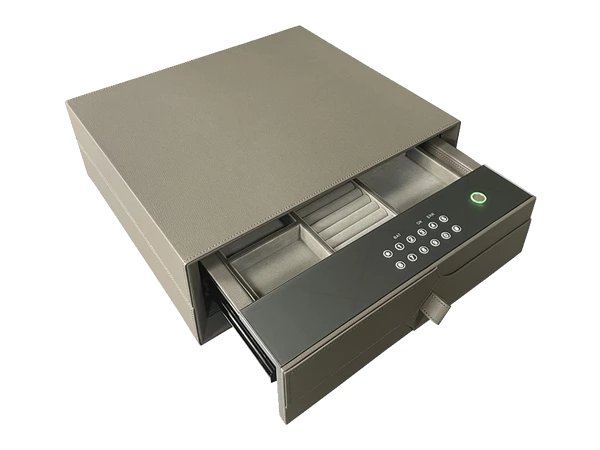
A smart safe drawer for wardrobe use is a secure storage unit designed in a horizontal drawer format rather than the conventional upright box shape.
Depending on the model, it may use:
- Fingerprint access
- Digital password access
- Electronic touch controls
- Emergency management access
- Jewelry organizer trays
- Watch storage
- Divided compartments
- Leather or microfiber finishes
- Custom drawer fronts
- Built-in furniture installation
The safe body itself can still use a strong metal structure, while the visible drawer front and interior are designed to work more naturally with residential or hospitality furniture.This combination is important.A wardrobe safe still needs to perform as security equipment, but in a premium room it is also part of the furniture experience.That is where drawer-style safes differ from ordinary hotel or household safe boxes.
Why Integrate a Safe Drawer Into a Wardrobe?
There are several reasons why a buyer may choose a drawer safe for a wardrobe rather than placing a traditional safe on a shelf.
The first is convenience.A horizontal drawer allows the user to look down into the storage area. Jewelry, watches and smaller valuables can be organized and reached without searching through a deep compartment.The second is space utilization.Luxury wardrobes often contain hanging areas, shoe storage, accessory drawers, watch storage and shelving. A low-profile drawer safe can fit more naturally into this layout than a tall safe box.The third is appearance.If the drawer front matches the surrounding furniture or uses a premium leather finish, the safe does not visually dominate the wardrobe.The fourth is privacy.A hidden drawer safe can be integrated into a section of cabinetry that is less obvious than an exposed safe on a wardrobe shelf.
For many buyers, these four points matter just as much as the electronic lock itself.
What Types of Smart Safe Drawers Are Available?
Not every drawer safe is designed for the same purpose.Some prioritize fast access. Others focus on jewelry organization. Some are intended to disappear into furniture, while others use leather and decorative detailing as part of the room design.Understanding these differences makes the selection process much easier.
Fingerprint Smart Safe Drawer
A fingerprint drawer safe is useful when the owner wants quick access without entering a password every time.For a private bedroom, dressing room or walk-in closet, this can be particularly convenient. The owner approaches the wardrobe, verifies a fingerprint and opens the drawer without carrying a key.
Fingerprint access can work well for:
- Luxury homes
- Private dressing rooms
- Walk-in closets
- Executive residences
- Serviced apartments
- Premium hotel suites
For commercial or shared environments, however, the user management process should be considered carefully.If many different people will use the safe, password access or a combination of fingerprint and password functions may provide more flexibility.
Password Electronic Drawer Safe
A password drawer safe uses a digital keypad or touch-control panel for access.This is a familiar system for many users and can be suitable for both residential and hospitality applications.One advantage is that access can normally be changed without replacing a physical lock.For hotel projects, serviced apartments and guest rooms, the simplicity of the operating process is important. A control panel should be easy to understand even for someone using the safe for the first time.A visually impressive interface is useful only if the user can operate it without needing instructions every time.When evaluating an electronic drawer safe, buyers should therefore look beyond the appearance of the control panel and ask how easy the safe will be to use in everyday situations.
Fingerprint and Password Combination Safe
For buyers who want more flexibility, a dual-access model can combine fingerprint recognition and digital password entry.This type of smart wardrobe safe is particularly suitable for high-end residential projects because different members of a household may prefer different access methods.It can also provide a useful alternative if one access method is temporarily inconvenient.For example, one person may normally use fingerprint recognition while another family member uses a personal code.In custom furniture projects, this type of lock system can provide modern functionality without changing the basic drawer-style appearance.
Jewelry Organizer Drawer Safe
For clients storing rings, bracelets, necklaces, earrings and watches, the interior design matters almost as much as the lock.A conventional safe often provides one large empty compartment.That is practical for documents and larger objects, but it is not ideal for delicate jewelry.
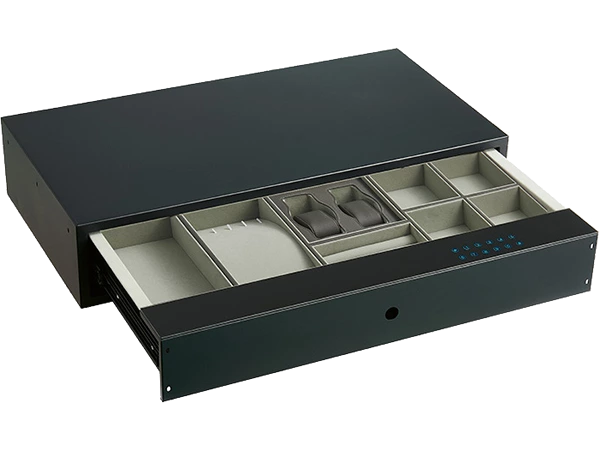
A jewelry drawer safe can include divided sections so different items remain separated. Ring slots, larger open compartments and smaller accessory sections can all be incorporated into the same drawer.This helps prevent watches and jewelry from moving together or scratching each other.
It also makes the contents easier to see.Instead of opening a safe and searching through boxes, the user can open one organized drawer and immediately see where each item is stored.For collectors and luxury homeowners, this is a significant improvement in daily use.
Hidden Built-In Drawer Safe
A built-in drawer safe is designed to become part of the wardrobe rather than sitting independently inside it.This can work particularly well in custom cabinetry.The safe may be installed behind a wardrobe panel, beneath an accessory drawer or inside a dedicated furniture module.The goal is not necessarily to make the safe impossible to find. In most cases, the more useful objective is simply to make it discreet.A safe that is hidden too aggressively can become inconvenient for the person using it every day.Good furniture integration balances concealment with accessibility.
Leather-Covered Luxury Drawer Safe
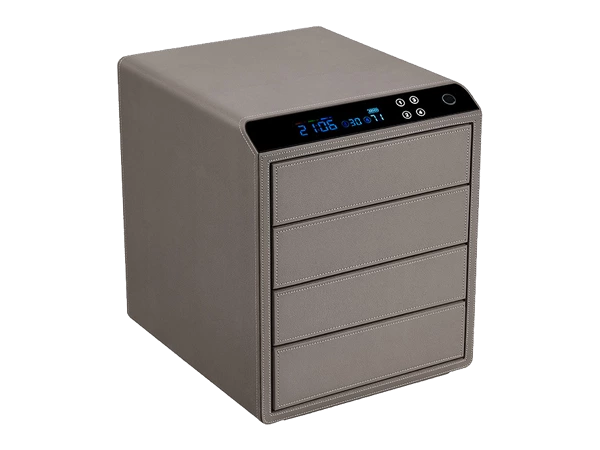
For premium residential and hospitality interiors, buyers may not want an exposed black metal front.A leather-covered safe provides another option.The visible drawer front can use leather or microfiber materials to coordinate with surrounding wardrobes, bedside cabinets or dressing furniture.
This type of luxury wardrobe safe is particularly suitable for projects where appearance is part of the purchasing decision.The security structure remains functional, while the surfaces that the user sees and touches feel more consistent with the furniture around them.This is one reason leather drawer safes are commonly considered for luxury homes, villas, executive suites and high-end custom furniture.
Which Smart Safe Drawer Is Best for Jewelry and Watches?
Jewelry and watches require a slightly different approach from documents or cash.They are usually smaller, more delicate and more likely to be stored as a collection.For this purpose, a safe drawer with jewelry compartments is generally more practical than one large open storage area.An effective interior layout may include several types of compartments.
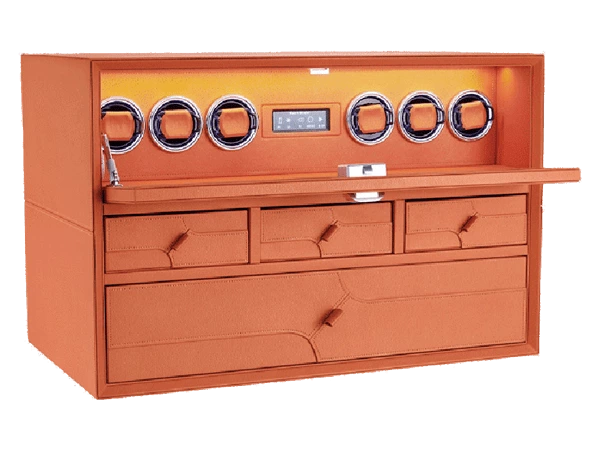
Ring sections can keep small pieces separated. Wider areas can accommodate bracelets or larger accessories. Dedicated watch spaces can prevent individual watches from contacting each other.For collectors, visibility also matters.A drawer-style organizer lets the owner view the collection from above without removing several boxes to find one item.This makes the safe more useful as part of a daily dressing routine.
If the buyer intends to store passports, documents or larger objects as well, the interior layout should include at least one wider compartment rather than using the entire drawer for small jewelry sections.The right arrangement depends on what the user actually owns.
Smart Drawer Safe vs Traditional Wardrobe Safe
Both designs can provide secure storage, but they solve different furniture and usage problems.
| Feature | Smart Drawer Safe | Traditional Wardrobe Safe |
| Opening style | Horizontal drawer | Front-opening door |
| Furniture integration | Excellent | Moderate |
| Jewelry organization | Very good | Usually basic |
| Daily visibility of contents | Easy top view | Deeper compartment |
| Space use | Suitable for drawer layouts | Suitable for cabinet shelves |
| Luxury interior compatibility | High | Depends on design |
| Custom interior options | Flexible | Usually more limited |
| Best for | Jewelry, watches, personal valuables | Documents, electronics, general storage |
There is no need to treat one as universally better.If a wardrobe already has a suitable shelf compartment and the client mainly needs document storage, a conventional safe may be completely appropriate.If the wardrobe is being custom designed and the buyer wants jewelry storage, discreet access and a more integrated appearance, the wardrobe safe drawer becomes more attractive.
Where Can a Smart Safe Drawer Be Installed?
Wardrobes are the most obvious location, but they are not the only option.A drawer safe can be incorporated into several types of furniture.
Walk-In Closet
This is one of the most natural applications.A walk-in closet already contains accessory drawers, jewelry storage and clothing organization. Integrating a secure drawer into the same furniture allows valuables to stay close to where they are used.
Built-In Wardrobe
A built-in wardrobe safe can be positioned beneath hanging space, inside a middle drawer section or within a dedicated cabinet module.The installation should be planned according to the user's standing position so the keypad and drawer remain comfortable to reach.
Dressing Table
A dressing table can be suitable for smaller jewelry-focused safes.This works especially well when the owner wants secure storage near a mirror or dressing area.
Bedroom Cabinet
A bedroom cabinet provides another discreet location, particularly where a full walk-in closet is not available.
Bedside Furniture
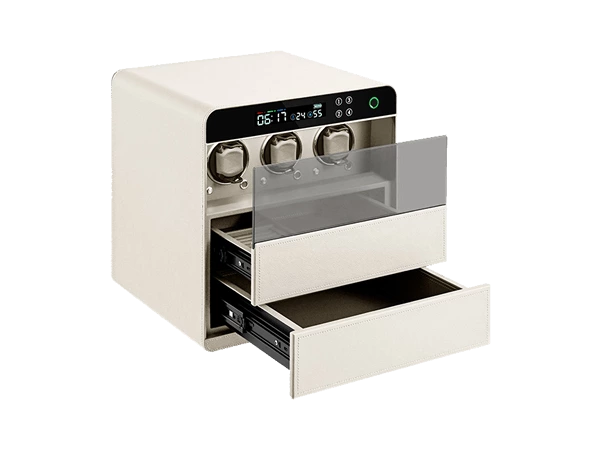
Compact drawer safes can also be incorporated into bedside units when the user wants passports, jewelry or personal items within easy reach.
Hotel Furniture
Luxury hotel rooms and serviced apartments may use drawer safes inside wardrobes or custom furniture to create a more refined alternative to standard in-room safes.The most suitable location depends on furniture size, security requirements and how frequently the safe will be used.
How Should You Choose the Right Drawer Safe Size?
Size should never be selected only by looking at the safe's external dimensions.
Three measurements matter:
External safe dimensions, usable internal space, and required furniture clearance.
A safe may physically fit inside the wardrobe but still fail to operate correctly if the drawer cannot fully extend.Drawer rails need enough room.The front panel needs suitable clearance.The user must also be able to reach the fingerprint sensor or keypad comfortably.For this reason, furniture dimensions should ideally be confirmed before the safe goes into production.
For custom projects, useful information includes:
| Required Information | Why It Matters |
| Cabinet internal width | Confirms whether the safe body can fit |
| Cabinet depth | Determines available safe depth |
| Available height | Prevents interference with other drawers |
| Drawer opening direction | Affects usability |
| Front clearance | Allows the drawer to extend fully |
| Installation position | Determines user access |
| Storage requirement | Helps define the internal layout |
A technically correct fit is more important than simply selecting the largest model possible.
What Should Interior Designers Consider Before Installation?
For interior designers, wardrobe companies and furniture manufacturers, the best time to select a safe is before the cabinetry drawings are finalized.If the safe is chosen after furniture production, the project may need unnecessary modifications.Several details should be reviewed early.
The first is the safe body's exact external size.The second is drawer travel. If the safe uses telescopic rails, the surrounding cabinetry must allow sufficient extension.The third is the control panel position.A fingerprint reader positioned too low or too close to another drawer may be uncomfortable to use.The fourth is the visible finish.If the wardrobe uses warm brown leather, walnut veneer or another distinctive material, the safe front may need to be coordinated with that visual language.
Finally, the installation method should allow future service access.A completely sealed installation may look clean when new but create problems if the safe ever requires maintenance.A successful furniture integrated safe should be attractive, usable and serviceable.
How Important Is the Interior Layout?
For a jewelry-focused product, the interior layout is one of the most important specifications.A buyer may have ten watches and only a few rings. Another customer may own necklaces, bracelets and many smaller jewelry pieces.The same tray design will not suit both.A well-planned interior should therefore reflect the intended storage.
Possible sections include:
- Watch compartments
- Ring slots
- Necklace areas
- Bracelet sections
- Open multipurpose storage
- Document space
- Passport storage
- Small electronic device storage
For OEM projects, the internal tray can often become one of the most valuable customization areas because it directly affects how the customer interacts with the product every day.
Should the Safe Match the Wardrobe Interior?
In a luxury project, usually yes.This does not mean every surface must use exactly the same material.It means the safe should look intentional.A black steel box installed in a light leather dressing room may be secure, but it can appear disconnected from the rest of the space.
Adding leather trim, a coordinated front panel or a refined organizer tray can make the product feel as though it was specified together with the furniture.For private homes, this creates a more polished result.For hotel and residential development projects, it can also support a consistent design standard across multiple rooms.
Can Smart Safe Drawers Be Customized for Furniture Projects?
Yes. Customization is one of the main reasons many furniture manufacturers and project buyers consider working directly with a drawer safe manufacturer rather than purchasing a standard retail model.
Depending on the model, order quantity and technical feasibility, customization may include:
| Customization | Typical Requirement |
| Overall dimensions | Match cabinet or wardrobe space |
| Drawer depth | Adapt to furniture construction |
| Interior compartments | Jewelry, watches, passports or mixed storage |
| Access method | Fingerprint, password or combination |
| Exterior trim | Leather or microfiber finish |
| Front panel appearance | Match furniture styling |
| Color | Coordinate with the interior |
| Logo | Brand or private-label requirements |
| Packaging | Distributor or project supply |
| Product configuration | Different room or furniture applications |
The earlier these requirements are confirmed, the easier the development process becomes.
Standard Drawer Safe or Custom Drawer Safe: Which Is Better?
A standard model is usually the better option when the available furniture dimensions already match an existing safe.It reduces development time and simplifies purchasing.A custom design becomes more valuable when the furniture is already highly specific.This is often the case with luxury wardrobes, branded residences, premium villas and designer hotel projects.The correct decision depends on the project.
For example, if a wardrobe company is producing 300 identical closet systems for an apartment project, adjusting the safe dimensions to match the furniture may be worthwhile.For a smaller project where an existing safe fits the available cabinet space, customization may add unnecessary complexity.A good manufacturer should be able to explain both options rather than automatically recommending customization.
What Should B2B Buyers Ask a Smart Safe Manufacturer?
Distributors, furniture manufacturers, hotel procurement companies and project buyers usually need more information than a household customer. Product appearance is only one part of the decision.
Before placing an OEM order, buyers should normally confirm:
Product Dimensions
Can the safe fit the intended cabinet?
Lock Configuration
Is fingerprint access required, password access, or both?
Interior Layout
What valuables will the end user store?
Surface Material
Is leather, microfiber or another finish required?
Installation Method
How will the safe be fixed inside the furniture?
MOQ
What is the minimum practical order for the requested customization?
Sample Process
Can a sample be reviewed before mass production?
Packaging
Will the product be delivered directly to a furniture factory, distributor or project site?
Production Lead Time
How much time should be allowed after sample approval?
These questions help prevent problems that are difficult to correct later.
How We Approach a Custom Wardrobe Safe Project
For a custom project, we normally start with the application rather than immediately choosing a model.
First, we need to understand where the safe will be installed.A wardrobe safe for a hotel room may require a different layout from a jewelry safe inside a private walk-in closet.Next, the available furniture dimensions are reviewed.The width, depth and height help determine which existing structure can be used or whether the safe needs to be modified.After that, the interior storage requirement becomes important.If the customer mainly stores watches, the tray should not be designed in the same way as one intended for documents or large jewelry pieces.
The lock type, exterior material and front appearance can then be considered.For larger OEM projects, confirming these details before sample production usually saves time later.It also allows the safe and furniture to be developed as one system rather than two unrelated products.
Who Typically Buys Furniture-Integrated Safe Drawers?
The market is wider than private homeowners.A custom furniture safe can be relevant to several B2B buyer groups.
Wardrobe Manufacturers
Wardrobe manufacturers may integrate the safe directly into a closet system and offer it as an upgrade to their own customers.
Interior Design Companies
Designers can specify the safe early in the furniture plan so its dimensions, location and finish work with the room.
Hotel and Hospitality Projects
Hotels may use drawer safes in executive rooms, villas or luxury suites where conventional steel safes do not fit the interior concept.
Property Developers
High-end residential developers may include secure storage as part of the master bedroom or walk-in wardrobe specification.
Safe Distributors
Distributors can add drawer-style and jewelry-focused products to complement conventional safes.
Luxury Furniture Brands
Furniture brands may use OEM manufacturing to develop a safe that becomes part of their own wardrobe or bedroom collection.The buying requirements of these groups are different, but all of them benefit from early technical coordination.
Is a Drawer Safe Only for Luxury Homes?
No.Luxury homes are a natural application because these projects often use custom furniture, but the drawer structure can also make sense in practical commercial settings.The important factor is not the price level of the room.It is whether the drawer format improves space use and user experience.
For example, a serviced apartment may use a simple black drawer safe without an elaborate leather finish.A hotel suite may use the same basic structure with a more refined front panel.A private villa may require custom jewelry storage.The internal security structure can be similar while the final appearance and configuration change according to the project.
What Should Be Stored in a Smart Safe Drawer?
A well-designed drawer safe is particularly suitable for small and medium-sized personal valuables, including:
- Watches
- Rings
- Necklaces
- Bracelets
- Earrings
- Passports
- Cash
- Important personal documents
- Wallets
- Keys
- Small electronic devices
For larger items, buyers should confirm the usable internal dimensions rather than relying on the overall size of the product.A drawer full of jewelry compartments may offer excellent organization but less open space for bulky objects.Again, the right design depends on the real storage requirement.
Is a Smart Drawer Safe Worth Adding to a Custom Wardrobe?
For the right user, yes. The value is not simply that the safe is hidden.The real benefit is that secure storage becomes part of the normal way the wardrobe is used.A person can dress, select a watch, put away jewelry and secure personal documents without walking to another part of the room.That convenience becomes especially valuable when the safe is used every day.The visual result is also cleaner.Instead of designing a beautiful wardrobe and then finding somewhere to place a conventional safe, the safe can be considered from the beginning.The difference may seem small on a furniture drawing.In the finished room, it is much more noticeable.
FAQ About Smart Safe Drawers for Wardrobes
Can a smart safe drawer be installed inside an existing wardrobe?
Yes, provided the wardrobe has enough internal width, depth and height for the safe and drawer mechanism. The available space should be measured carefully, including clearance for full drawer extension. If the existing cabinet does not match a standard model, a custom size may be considered for suitable project quantities.
What is the best drawer safe for jewelry and watches?
A drawer safe with divided jewelry compartments and dedicated watch storage is usually more practical than an empty safe compartment. The ideal layout depends on the size of the collection and whether the user also needs space for passports, documents or other valuables.
Are fingerprint drawer safes convenient for everyday use?
Yes. Fingerprint access can be very convenient in private bedrooms, wardrobes and walk-in closets because the owner does not need to enter a password for every opening. Some smart safes combine fingerprint and password access to give users more flexibility.
Can a wardrobe safe drawer be customized?
Depending on the model, quantity and manufacturing requirements, customization can include overall dimensions, interior compartments, leather or microfiber finishes, lock configuration, colors, logos and packaging.
Can smart drawer safes be supplied for hotel or furniture projects?
Yes. Drawer safes can be developed for furniture manufacturers, hotels, interior design companies, property developers and distributors. For project orders, furniture drawings or cabinet dimensions are useful for checking installation compatibility before production.
Is a hidden drawer safe better than a traditional safe?
It depends on the application. A hidden drawer safe is often better for furniture integration, jewelry organization and discreet access. A traditional safe may be more suitable when the buyer needs a larger open storage area for documents, electronics or bulky items.
Conclusion
The best smart safe drawer for wardrobe integration is not necessarily the model with the most functions. It is the one that fits the furniture properly, stores the right valuables, feels comfortable to use and suits the design of the room.For everyday jewelry and watches, an organized fingerprint or password drawer safe can provide both convenience and security. For luxury wardrobes, leather trim and customized compartment layouts can make the product feel more integrated with the furniture. For hotels, property developers and furniture manufacturers, custom dimensions and project coordination may be more important than decorative features.The key is to select the safe early enough.When wardrobe dimensions, drawer clearance, access method, interior organization and exterior finish are considered together, the safe becomes more than a metal box hidden inside a cabinet. It becomes part of the furniture.
Looking for a Custom Smart Safe Drawer for Your Wardrobe Project?
We manufacture smart drawer safes, fingerprint and password safes, jewelry organizer safes, wardrobe safes, leather-covered luxury safes and customized furniture-integrated security solutions for residential, hospitality and commercial projects.For wardrobe manufacturers, interior designers, hotel procurement companies, developers, distributors and private-label buyers, we can evaluate your project according to the available cabinet dimensions, required storage layout, access method, finish and order quantity.Send us your wardrobe dimensions, furniture drawing, required quantity or preferred safe configuration to discuss a suitable OEM smart safe solution.