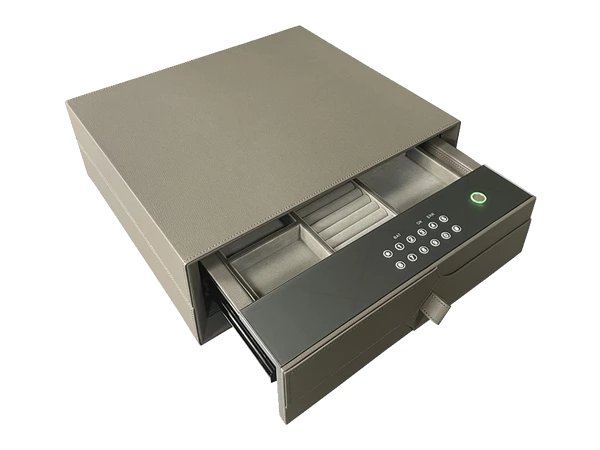
Germany Buyer Case: Minimalist Fingerprint Jewelry Storage Box for Modern Furniture Design
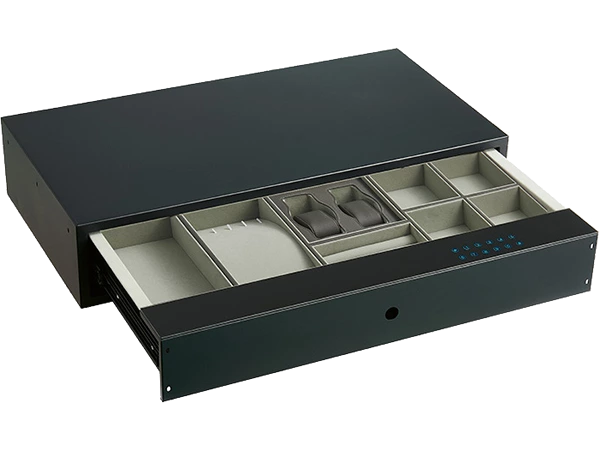
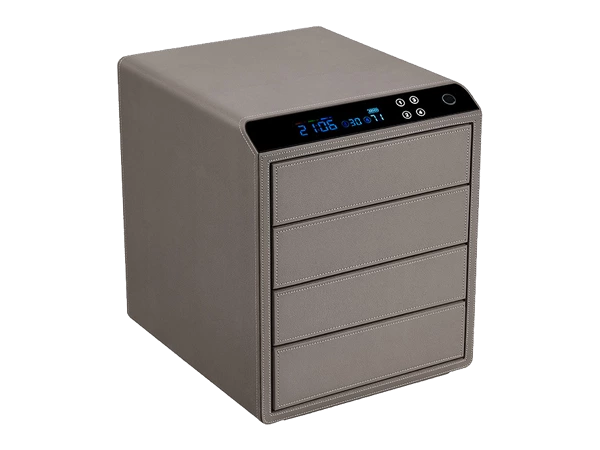
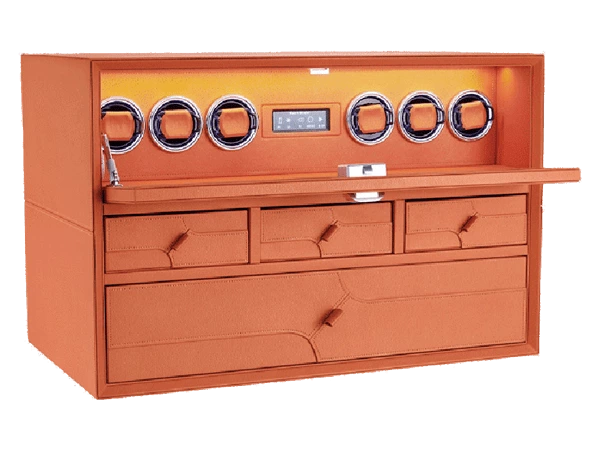
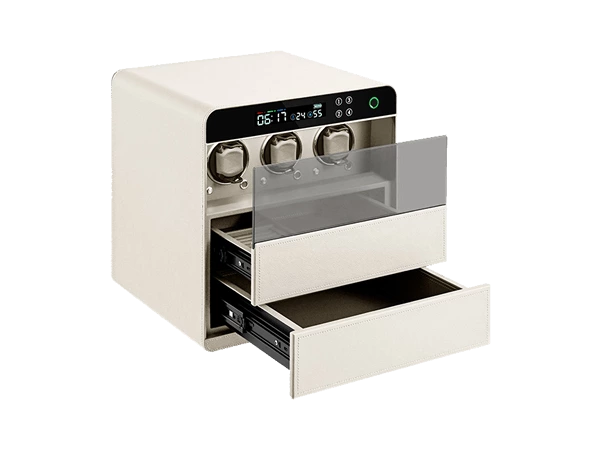
A German furniture manufacturer required a jewelry-storage solution for a jewelry room where the product needed to work visually with modern furniture rather than appear as a conventional industrial safe. The selected fingerprint jewelry storage box, model BGX-DX1-BPM-18, combines a compact alloy-steel structure with wear-resistant simulated leather, a velvet-finished interior, and fingerprint-controlled access.Two sizes are included in the supplied specification: a smaller 23 × 22 × 15 cm version weighing 4 kg and a larger 33.5 × 22.5 × 15 cm version weighing 5.4 kg. The listed storage capacity is 100 pieces, while size, color, multilayer configuration, and inner-box design can be customized according to project requirements.For a furniture manufacturer, those details matter because the product must solve both a storage problem and a design problem. It has to organize jewelry efficiently while fitting the proportions, finishes, and visual restraint of the surrounding furniture.
Project Overview
The project involved a German furniture manufacturer specifying a jewelry storage product for a dedicated jewelry-room environment.That buyer profile makes external dimensions, surface finish, internal organization, and visual simplicity especially relevant. A jewelry box may technically hold valuables, but it still has to work with the furniture around it. Conversely, a conventional heavy safe may provide enclosed storage but can introduce unnecessary visual weight into a minimalist interior.The selected Jewelry Storage Box sits between those two categories: it uses a metal structural body and fingerprint-controlled access while keeping the external form compact and furniture-oriented.
| Project Item | Details |
| Market | Germany |
| Client Type | Furniture Manufacturer |
| Application | Jewelry Room |
| Product | Jewelry Storage Box |
| Model | BGX-DX1-BPM-18 |
| Access System | Fingerprint lock |
| Structural Material | Alloy steel plate |
| Exterior Material | Wear-resistant simulated leather |
| Interior Material | Velvet |
| Listed Storage Capacity | 100 pieces |
| Small Size | 23 × 22 × 15 cm, 4 kg |
| Large Size | 33.5 × 22.5 × 15 cm, 5.4 kg |
| Accessories | User Manual ×1, Emergency Charging Cable ×1, Warranty Card ×1, Qualification Certificate ×1 |
| Customization | Size, color, multilayer configuration and inner-box design |
| Project Objective | Combine organized jewelry storage, fingerprint access and minimalist furniture compatibility |
Dimension Verification Note
The supplied dimensions include a tolerance notation of ±3 cm.A ±3 cm tolerance is significant for a product intended to coordinate with furniture dimensions. If the intended tolerance is ±3 mm or another value, the technical table should be corrected before the page is published.
Understanding the Furniture Manufacturer’s Requirements
The main requirement was not simply high storage capacity. The jewelry box needed to fit the design language of a modern jewelry room.For furniture manufacturers, visible proportions matter. Product height affects how the box works on a shelf or within cabinetry. Width and depth affect whether it can be placed inside a drawer system, cabinet module, or dedicated jewelry-storage zone.Material selection also changes the way the product is perceived.An exposed steel shell may communicate security but can appear visually heavy within a minimalist room. Simulated leather softens the exterior appearance, while the steel plate underneath provides the structural body.Inside, velvet creates a different contact surface from painted or bare metal. Jewelry is handled frequently, so the tactile quality of the interior becomes part of everyday use.Fingerprint access introduces controlled opening without requiring the product to look like a large mechanical safe.
Project Requirements Tree
Germany Jewelry Room Project
│
├── Furniture Compatibility
│ ├── Compact proportions
│ ├── Minimalist appearance
│ ├── Two size options
│ └── Custom dimensions
│
├── Access
│ └── Fingerprint lock
│
├── Material Structure
│ ├── Alloy steel plate
│ ├── Wear-resistant simulated leather
│ └── Velvet interior
│
├── Jewelry Organization
│ ├── Listed capacity: 100 pieces
│ ├── Multilayer configuration
│ └── Custom inner-box design
│
└── Project Customization
├── Size
├── Color
├── Internal layers
└── Compartment layout
Why a Generic Jewelry Box Was Not the Right Fit
A decorative jewelry box and a fingerprint-controlled jewelry storage box solve different requirements.A conventional jewelry box may organize rings, bracelets, necklaces, and watches effectively, but it may rely only on a basic latch or mechanical closure. For a furniture project where controlled access is required, that may not be enough.At the opposite end, a conventional freestanding safe can introduce unnecessary bulk when the primary requirement is organized jewelry storage inside a designed room.This project called for a more compact middle ground.The fingerprint access system provides controlled opening without turning the product into a visibly industrial cabinet. The simulated-leather exterior helps it relate more naturally to furniture and luxury storage environments.The velvet interior is also directly relevant to the product category. Jewelry-storage quality depends on more than the amount of empty volume inside the box. Compartments, surface materials, and item separation affect how practical that volume becomes.For this reason, the fingerprint jewelry storage box was evaluated as an organized furniture accessory with controlled access rather than simply a smaller version of a traditional safe.No burglary, fire, insurance, or other certified security classification has been supplied for this project and none should be implied.
The Jewelry Storage Solution Selected for the Project
For this project, the selected solution was the BGX-DX1-BPM-18 Jewelry Storage Box.The product combines several material layers with different functions.Alloy steel plate provides the structural body. Wear-resistant simulated leather forms part of the visible exterior finish, creating a softer and more furniture-compatible appearance. Velvet is used inside the box where stored jewelry comes into contact with the interior.Fingerprint-controlled access provides the main locking method listed in the supplied specification.This is an important technical distinction: the fingerprint lock is an access system, not a material. For website and catalogue specifications, it should therefore be listed separately from the steel, simulated leather, and velvet.Two standard size formats are supplied.The smaller version measures 23 × 22 × 15 cm and weighs 4 kg. The larger version measures 33.5 × 22.5 × 15 cm and weighs 5.4 kg.These options allow the buyer to choose between a more compact footprint and a wider storage format before considering additional customization.
Key Product Configuration
| Configuration | Project Specification | Why It Matters |
| Product | Jewelry Storage Box | Focuses the product around organized jewelry storage |
| Model | BGX-DX1-BPM-18 | Provides clear product identification |
| Access | Fingerprint lock | Adds controlled biometric access |
| Structural Material | Alloy steel plate | Provides the rigid internal structure |
| Exterior Finish | Wear-resistant simulated leather | Creates a furniture-oriented appearance |
| Interior | Velvet | Provides a softer surface around stored jewelry |
| Listed Capacity | 100 pieces | Supports relatively large jewelry collections |
| Small Size | 23 × 22 × 15 cm | Provides the more compact format |
| Small Weight | 4 kg | Useful for furniture and logistics planning |
| Large Size | 33.5 × 22.5 × 15 cm | Provides a wider storage format |
| Large Weight | 5.4 kg | Useful for furniture and logistics planning |
| Emergency Accessory | Emergency charging cable | Supports the product’s emergency charging provision |
| Customization | Size / Color / Multilayer / Inner Box | Allows the product to respond to different furniture projects |
Capacity Note
The supplied specification lists a storage capacity of 100 pieces.The practical number of items that can be stored will depend on jewelry size, compartment dimensions, and the final inner-box configuration. A collection dominated by rings and earrings will use space differently from one containing large watches, bracelets, or necklaces.For this reason, “100 pieces” should be presented as the supplied product capacity rather than a guarantee that every combination of 100 jewelry items will fit identically.
Why Minimalist Design Matters in Furniture Projects
Minimalism in a furniture project is not simply the absence of decoration. It depends on proportion, material consistency, visual restraint, and how objects relate to the surrounding space.A jewelry room often contains several visually detailed elements already: jewelry displays, lighting, mirrors, glass cabinets, wardrobe surfaces, and accessories.The storage box therefore does not need additional visual complexity to look premium.A compact geometry, controlled surface treatment, and restrained simulated-leather finish can make the product easier to position within modern furniture.The fingerprint lock also contributes to this approach because access can be integrated without requiring an oversized mechanical lock assembly.For furniture manufacturers, this means the jewelry box can be treated as part of the furnishing scheme rather than as unrelated security equipment placed into the room later.
Jewelry Organization and the 100-Piece Storage Specification
The usefulness of a jewelry box depends largely on its internal organization.The supplied specification gives a storage capacity of 100 pieces, but capacity alone does not define a good jewelry-storage system.Rings require small individual spaces. Earrings can be stored compactly but benefit from separation. Watches and bracelets need wider sections. Necklaces require layouts that help limit tangling or unnecessary contact.The confirmed customization options therefore matter as much as the headline capacity.Multilayer configuration allows the available height to be divided into several storage zones. Custom inner-box design allows those zones to be adapted to the intended collection.The exact divider arrangement supplied for the German project has not been provided.Without those details, the most accurate statement is that the product provides a listed 100-piece capacity with customizable multilayer and inner-box organization.
Two Size Options for Different Furniture Requirements
The two supplied sizes make the BGX-DX1-BPM-18 suitable for different spatial requirements.The small version measures 23 × 22 × 15 cm and weighs 4 kg.The large version measures 33.5 × 22.5 × 15 cm and weighs 5.4 kg.The common 15 cm height creates a useful relationship between the two versions. The main change is the footprint rather than a much taller cabinet.For furniture manufacturers, this can simplify visual coordination where a consistent low-profile form is preferred.However, furniture integration should never be based only on nominal dimensions. The actual opening method, surrounding clearance, access to emergency charging, and final manufacturing tolerance should also be checked before a cabinetry drawing is finalized.
Emergency Charging and Accessory Planning
The product is supplied with one emergency charging cable, and the specification includes an important usage note:The emergency charging cable should not be stored inside the jewelry box.This is a practical point because an emergency accessory is only useful if it can still be accessed when the main storage box cannot be opened normally.For distributors and furniture buyers, this type of operational detail is worth retaining in the final manual rather than treating it as minor packaging information.
The supplied accessory list includes:
- User Manual ×1
- Emergency Charging Cable ×1
- Warranty Card ×1
- Qualification Certificate ×1
The presence of a warranty card does not establish a specific warranty period unless that period is separately documented.Likewise, the listed “Qualification Certificate” should not be presented as evidence of CE, UL, TÜV, burglary, fire, material-safety, or any other third-party certification unless the issuing body and applicable standard are confirmed.
Customization for the German Furniture Project
The confirmed customization scope includes size, color, multilayer configuration, and inner-box design.For a furniture manufacturer, these four areas affect both function and appearance.
Size
Custom dimensions allow the jewelry box to respond to shelf width, cabinet depth, drawer modules, or a dedicated furniture recess.If custom dimensions are used, the relationship between overall size, internal capacity, and structural layout should be reviewed together.
Color
Color customization allows the simulated-leather exterior to work more naturally with different furniture palettes.A minimalist interior may call for neutral or low-saturation finishes, but no specific German project color has been supplied and none should be invented.
Multilayer Configuration
Adding or adjusting storage layers can change how efficiently internal space is used.Shallow trays can be practical for smaller jewelry, while deeper sections may be required for watches or larger accessories.
Inner-Box Design
The inner-box layout determines the actual organization of the collection.For furniture manufacturers developing a coordinated jewelry room, this can be specified together with the exterior furniture rather than left as an afterthought.
Customization Structure
Fingerprint Jewelry Storage Box
│
├── Exterior
│ ├── Custom size
│ └── Custom color
│
├── Structural Format
│ ├── Small size
│ └── Large size
│
├── Internal Architecture
│ ├── Custom layer quantity
│ └── Layer depth allocation
│
└── Jewelry Organization
├── Custom inner box
└── Compartment layout
Manufacturing and Quality Considerations
A jewelry storage box with fingerprint access combines several manufacturing requirements that have to work together within a compact product.The alloy-steel body provides the structural foundation. Its dimensions affect the fit of the outer simulated-leather finish, fingerprint locking system, internal trays, and velvet lining.For a furniture-oriented product, surface consistency matters because the exterior remains visible. Simulated leather should be fitted cleanly around corners, edges, and joints so that the product looks intentional when placed alongside finished cabinetry.The velvet interior requires similar attention. Wrinkles, loose edges, poorly aligned dividers, or exposed substrate would be immediately visible in a product positioned as premium jewelry storage.The fingerprint module also needs to align correctly with the surrounding structure and operate consistently with the locking mechanism.When multiple size versions are produced, maintaining the intended proportions and internal fit across both versions becomes another manufacturing consideration.No verified fingerprint-cycle count, steel thickness, wear test, load test, drop test, material-safety result, or certified security rating has been supplied for this project.Those figures should only be published when supported by genuine technical documentation.
From Furniture Requirement to Product Configuration
Based only on confirmed project information, the development path can currently be represented as follows:
German Furniture Manufacturer
↓
Jewelry Room Application
↓
Minimalist Storage Requirement
↓
BGX-DX1-BPM-18 Selected
↓
Fingerprint Access
↓
Material Configuration
↓
Alloy Steel + Simulated Leather + Velvet
↓
Size Selection
↓
Small / Large Format
↓
Customization Scope
↓
Size + Color + Multilayer + Inner Box
↓
[FACT NEEDED: Drawing / Sample Confirmation]
↓
[FACT NEEDED: Production and Inspection]
↓
[FACT NEEDED: Final Furniture Integration]
If actual furniture drawings, customization drawings, production photographs, close-up workmanship images, or completed jewelry-room photography are available, they would add substantial value to this section.For a B2B furniture buyer, this evidence demonstrates how dimensions, materials, and internal organization were translated into a physical product.
The Final Product Configuration
Based on the information supplied, the German project established a compact jewelry-storage configuration centered on three priorities: controlled fingerprint access, organized storage, and compatibility with minimalist furniture.The BGX-DX1-BPM-18 uses an alloy-steel structural body beneath a wear-resistant simulated-leather finish. A velvet interior provides the jewelry-contact surface.Two sizes allow different space requirements to be considered, while the listed 100-piece capacity supports larger personal collections.Customization in size, color, storage layers, and inner-box design gives the furniture manufacturer additional flexibility when coordinating the jewelry box with the room.What has not been supplied is a verified completed installation result.Until then, the page should describe the confirmed product specification and furniture-design solution rather than imply a completed installation that has not been documented.
What Furniture Buyers Can Learn From This Project
The first lesson is that jewelry-storage capacity should not be evaluated by one number alone. A listed 100-piece capacity is useful, but tray depth, compartment shape, and the types of jewelry being stored determine how practical that capacity is.Second, furniture dimensions and product dimensions should be coordinated early. For a compact jewelry box, a few centimeters can materially affect whether the product fits the intended cabinet or display area. Manufacturing tolerances therefore need to be accurate and clearly documented.Third, materials should be evaluated by function. Steel provides structure, simulated leather affects the visible furniture relationship, and velvet affects contact with stored jewelry. Listing these elements separately gives buyers a clearer understanding of the product.Fourth, smart access should be described precisely. A fingerprint lock is a useful access feature, but it should not be converted into an unsupported burglary or insurance rating.Finally, customization is most valuable when it solves a real storage or furniture problem. Adjusting size, layers, and inner-box organization can be more important than adding decorative features that do not improve usability.
Frequently Asked Questions
Can the jewelry storage box be customized for furniture projects?
Yes. Size, color, multilayer configuration, and inner-box design are included in the confirmed customization scope. Furniture manufacturers should provide the available installation dimensions, surrounding furniture structure, intended jewelry categories, and preferred finish. If the storage box will sit inside cabinetry, final dimensions and manufacturing tolerances should be confirmed before the furniture enters production.
How much jewelry can the storage box hold?
The supplied specification lists a capacity of 100 pieces. Actual usable capacity depends on the size and type of jewelry and the final compartment layout. Rings and earrings require less space than watches, bracelets, or larger accessories. For a project with a specific collection profile, the inner-box configuration should be evaluated rather than relying only on the headline capacity.
What materials are used in the BGX-DX1-BPM-18?
The supplied construction information includes alloy steel plate, wear-resistant simulated leather, and a velvet interior. The fingerprint lock should be treated as the access system rather than as a material. This distinction is useful for B2B buyers because structural materials, surface materials, interior materials, and electronic components perform different functions.
What sizes are available?
The supplied specification includes a small size of 23 × 22 × 15 cm at 4 kg and a large size of 33.5 × 22.5 × 15 cm at 5.4 kg. The specification also states a ±3 cm tolerance, which should be confirmed before publication or furniture integration because exact dimensional control is particularly important in cabinetry projects.
What happens if emergency charging is needed?
An emergency charging cable is listed among the supplied accessories. The product instructions specifically state that this cable should be kept outside the jewelry box rather than stored inside it. Exact electrical specifications for emergency charging have not been provided, so voltage, charging time, and related values should be published only after technical confirmation.
Is the jewelry storage box certified as burglary-resistant or fire-resistant?
No such certification information has been supplied for this case. The product includes an alloy-steel structure and fingerprint-controlled access, but these features should not be interpreted as a certified burglary, fire, or insurance rating. If a particular project requires a recognized security classification, the applicable standard and supporting documentation should be confirmed separately.
Planning a Similar Jewelry Storage Project?
For furniture manufacturers, wardrobe companies, interior designers, jewelry-storage brands, and OEM/ODM buyers, the best starting point is to define both the collection and the furniture environment.Provide the available dimensions, intended jewelry categories, preferred exterior finish, required storage capacity, and desired internal organization. If the product needs to sit inside custom cabinetry, include furniture drawings and dimensional restrictions where available.From there, size, color, multilayer configuration, and inner-box design can be evaluated together so that the jewelry storage box works as part of the furniture system rather than as a separate accessory added after the room has already been designed.