USA Dealer Case: Developing a Private Label Jewelry Safe Line for Hotel Suites
A U.S. safe distributor approached this project from a product-line perspective rather than as a single end-user installation. The objective was to configure a private label jewelry safe around a premium hotel-suite application, with enough customization flexibility to support a distributor-led product offering.
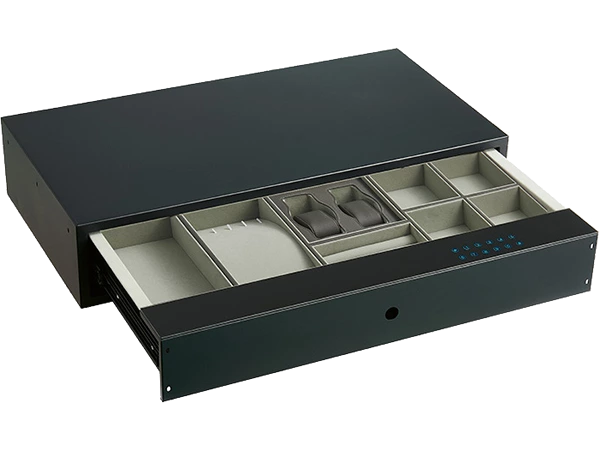
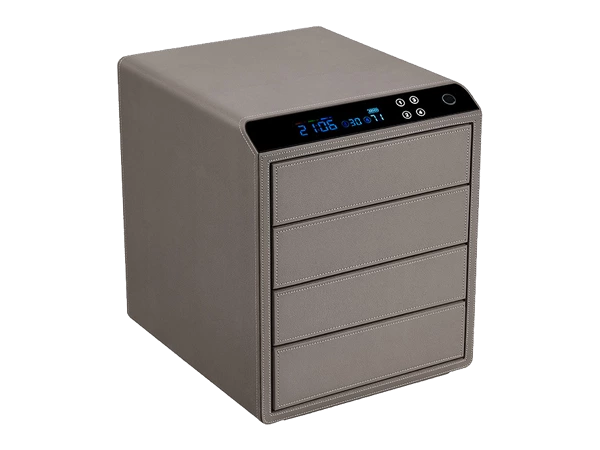
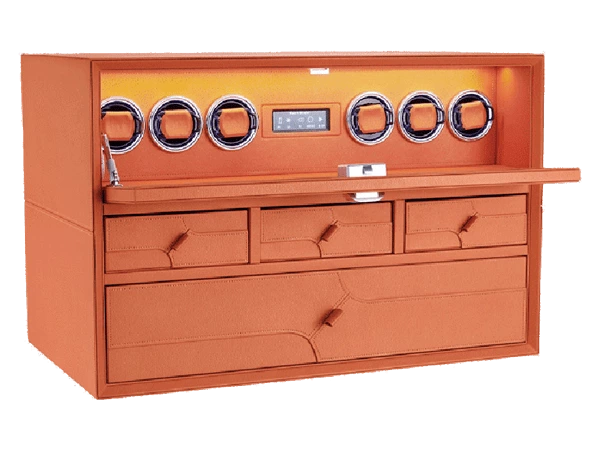
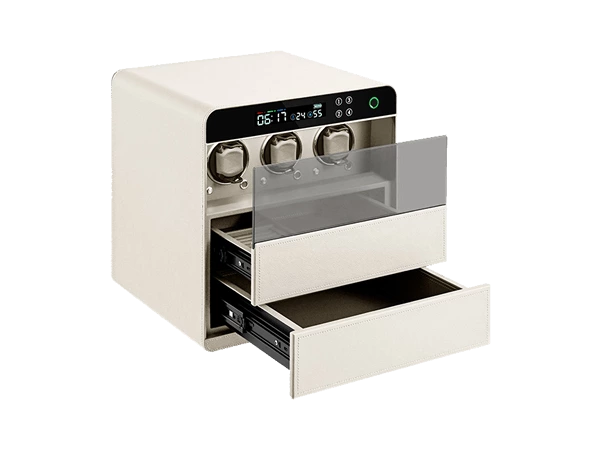
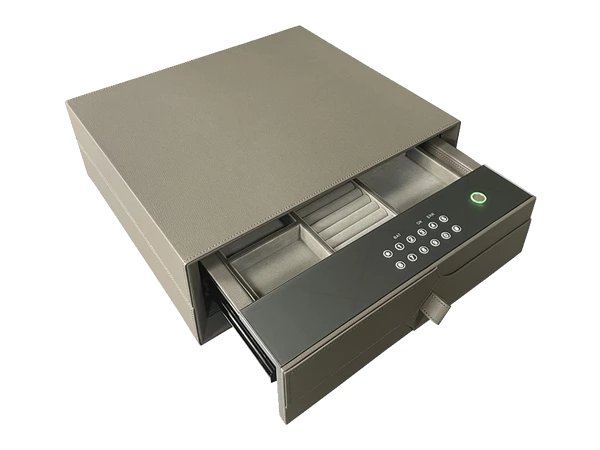
The selected platform was a Luxury Leather Jewelry Safe with a tempered glass control interface, fingerprint and password unlocking, a mechanical backup key, customized internal storage, and an automatic pop-up opening structure that avoids a conventional protruding handle. The product can also be adjusted in size, color, number of internal layers, and inner-box design.
For a distributor, those variables matter because a private label program has to address more than appearance. The safe needs a coherent product structure, practical access system, useful interior organization, and a customization framework that can be repeated across future configurations.
Project Overview
This case concerns a U.S. safe distributor developing a jewelry-safe product offering around a hotel-suite application.That buyer profile changes the project priorities. A hotel or individual homeowner may evaluate one safe against one room requirement. A distributor has to think about the product as a repeatable commercial platform: what functions remain standard, which elements can change, and which specifications require technical confirmation before the product is marketed.The supplied configuration combines intelligent access with organized interior storage and a furniture-oriented exterior.
| Project Item | Details |
| Market | USA |
| Client Type | Safe Distributor |
| Application | Hotel Suite |
| Product Type | Luxury Leather Jewelry Safe |
| Product-Line Direction | Private Label Jewelry Safe |
| Control Interface | Tempered glass touch-sensitive panel |
| Unlocking Methods | Fingerprint, digital password and mechanical key |
| Interior | Customized storage box |
| Opening Structure | Automatic pop-up, handle-free design |
| Emergency Measures | Mechanical key + Type-C interface |
| Customization | Size, color, multilayer configuration and inner-box design |
| Project Objective | Develop a customizable jewelry-safe platform suitable for distributor-led hotel-suite product positioning |
Understanding the Distributor’s Requirements
The key requirement was not simply to make a standard safe look more luxurious. The product needed to make sense as a jewelry-storage category within a distributor’s offering.Jewelry presents a different storage problem from documents or cash. Individual items are smaller, often accessed more frequently, and benefit from separated storage rather than being placed together inside one open steel compartment.The hotel-suite context adds another consideration.
The safe may form part of a designed bedroom, wardrobe, dressing, or furniture environment. A large exposed handle and purely industrial interior may therefore conflict with the intended product positioning.Smart access also needed to be considered together with backup operation. Fingerprint recognition and password entry support normal electronic access, while the mechanical key provides a physical alternative.For private label development, the distributor also needs to decide which product characteristics should remain consistent across the line and which can be customized for different versions.
Project Requirements Tree
USA Private Label Jewelry Safe Program
│
├── Product Positioning
│ ├── Luxury jewelry storage
│ ├── Hotel-suite application
│ └── Distributor product line
│
├── Smart Access
│ ├── Fingerprint unlocking
│ ├── Digital password
│ └── Mechanical backup key
│
├── Exterior Design
│ ├── Luxury leather styling
│ ├── Tempered glass interface
│ └── Handle-free opening
│
├── Interior Storage
│ ├── Customized storage box
│ ├── Multilayer configuration
│ └── Custom inner-box design
│
└── Private Label Development
├── Size customization
├── Color customization
├── Product configuration
└── Brand elements
└── [FACT NEEDED]
Why a Generic Hotel Safe Was Not the Right Product Direction
A generic hotel safe and a private label jewelry safe solve different storage and product-positioning problems.A conventional hotel safe is often evaluated primarily around usable internal space and guest access. A jewelry-focused product places more emphasis on organized interior storage, materials, presentation, and the way smaller valuables are arranged.For the U.S. distributor, the distinction matters commercially.If the intended product line is positioned around jewelry and premium valuables storage, using the same open interior found in a generic safe would provide limited differentiation. A customized storage box allows the inside of the product to respond more directly to jewelry, watches, accessories, and other small valuables.
The exterior architecture also supports a different presentation.The specified safe uses a tempered glass control interface and an automatic pop-up mechanism rather than a conventional exposed handle. These details can make the safe visually easier to coordinate with premium hotel furniture or bedroom interiors.None of these characteristics should be interpreted as proof of a particular hotel-security, burglary, fire, or insurance classification.No corresponding test standard or certification has been provided for this project.
The Private Label Jewelry Safe Platform
For this project, the selected base product was a Luxury Leather Jewelry Safe configured around intelligent electronic access and customizable internal storage.The operating area uses a tempered glass interface with touch-sensitive controls.Fingerprint recognition provides one electronic access method. A digital password provides another.The mechanical key serves as physical backup access.This distinction should remain clear in distributor literature. Fingerprint recognition, password entry, and a mechanical key provide different access paths, but the number of access options does not by itself establish a certified security level.The interior uses a customized storage box rather than relying only on a large unrestricted compartment.This is particularly relevant for a jewelry-safe product line because the internal organization can become one of the strongest differences between configurations.The safe also incorporates an automatic pop-up opening structure. Removing the need for a conventional external handle gives the front a cleaner appearance and can support furniture-oriented applications.
Key Safe Configuration
| Configuration | Project Specification | Why It Matters |
| Product Type | Luxury Leather Jewelry Safe | Establishes the premium jewelry-storage positioning |
| Control Interface | Tempered glass touch panel | Creates a cleaner electronic operating surface |
| Biometric Access | Fingerprint recognition | Supports convenient electronic access |
| Alternative Access | Digital password | Provides another electronic unlocking method |
| Backup Access | Mechanical key | Provides a physical emergency access method |
| Opening Structure | Automatic pop-up | Allows a handle-free front design |
| Interior | Customized storage box | Supports organized valuables storage |
| Cabinet | All-steel fabrication | Forms the structural body of the safe |
| Emergency Interface | Type-C connection | Included as part of the supplied emergency configuration |
| Custom Dimensions | Available | Supports different product or furniture requirements |
| Color Customization | Available | Supports differentiated product styling |
| Internal Layers | Customizable | Allows storage capacity to be structured differently |
| Inner-Box Design | Customizable | Allows jewelry organization to respond to target users |
Type-C Technical Note
The project information describes the Type-C connection as part of the product’s emergency measures.Until that function is technically verified, distributor literature should avoid describing the port more specifically.
Designing the Interior Around Jewelry Rather Than Empty Volume
A jewelry safe should be evaluated by usable organization, not simply total internal volume.Jewelry collections contain items with very different shapes and storage requirements. Rings and earrings require relatively little space. Bracelets, watches, necklaces, documents, and larger personal valuables need different dimensions.This is why the custom inner-box design matters.Instead of making one large compartment and asking the end user to organize it later, the interior can be planned as part of the product.
For a distributor, that creates opportunities to develop different configurations from the same basic safe architecture. One version may focus heavily on jewelry organization. Another may combine jewelry compartments with larger valuables storage.The exact compartment structure selected for the U.S. project has not been provided.Until then, the accurate statement is that multilayer storage and inner-box design are customizable.
Why the Handle-Free Automatic Pop-Up Design Matters
The automatic pop-up design changes both appearance and user interaction.A conventional safe often relies on a visible mechanical handle. That structure is recognizable and functional, but it may not fit the visual direction of a premium jewelry-safe product intended for hospitality or luxury furniture environments.The handle-free design creates a cleaner front.
After the correct unlocking process, the automatic opening structure provides access without requiring a permanently protruding handle.For product development, opening geometry still matters. The cabinet, surrounding furniture, drawer travel, and available clearance need to be considered together if the safe is being installed within furniture.Exact opening travel and installation clearance have not been supplied for this case.
Smart Access and Emergency Measures
A private label smart safe should distinguish between normal access and emergency access clearly.Fingerprint recognition provides a biometric option for routine operation.The digital password provides another electronic access method.The mechanical key provides physical backup.The Type-C interface addresses the electrical side of the emergency configuration, although its exact function requires technical confirmation.
For a dealer or distributor, documenting these functions accurately matters because downstream buyers may compare several models based on what happens if the primary access method cannot be used.The safest product literature explains each access method individually instead of relying on broad claims such as “ultimate security” or “advanced anti-theft technology.”
Customization for a Private Label Product Line
The supplied project information confirms four product customization areas: size, color, multilayer configuration, and inner-box design.These create a practical foundation for developing differentiated jewelry-safe configurations.
Custom Size
Changing dimensions can help the product serve different furniture modules, storage capacities, or market segments.For hotel-suite applications, dimensions may also affect how easily the safe can be coordinated with bedroom or wardrobe furniture.The exact sizes selected for this project were not supplied.
Custom Color
Color customization allows different finishes to be developed around the distributor’s preferred product positioning.No confirmed project color has been provided.
Multilayer Configuration
Changing the number and allocation of internal layers can create different storage capacities without necessarily changing the basic product concept.A jewelry-oriented model may prioritize several organized storage levels, while another configuration may retain more space for larger valuables.
Inner-Box Design
The inner box determines how individual items are separated.For a private label jewelry-safe line, this can become one of the most visible points of product differentiation.
Private Label Branding
The article theme confirms that this project relates to a private label product line, but no specific branding implementation has been provided.The following elements therefore require confirmation before being described as completed:
- Custom logo application
- Private label nameplate
- Branded packaging
- Custom instruction manual
- Model-number system
- Retail or distributor labeling
- Packaging artwork
These should only be added to the final case when they are genuinely included in the distributor program.
Customization Structure
Private Label Jewelry Safe
│
├── Product Structure
│ ├── Custom size
│ └── Internal layer configuration
│
├── Appearance
│ ├── Custom color
│ └── Luxury leather styling
│
├── Storage
│ ├── Custom inner box
│ └── Jewelry organization
│
└── Brand Program
├── Logo [FACT NEEDED]
├── Nameplate [FACT NEEDED]
├── Packaging [FACT NEEDED]
└── Documentation [FACT NEEDED]
Manufacturing Considerations for a Distributor Product Line
Developing a product for distribution requires attention to repeatability as well as the appearance of the first sample.The steel cabinet establishes the basic structure. When several sizes are developed, overall dimensions, control-panel position, opening behavior, and internal storage components need to remain coordinated with each specific configuration.The tempered glass control panel must align correctly with the electronic access components.Fingerprint recognition, password operation, mechanical backup access, and the opening mechanism should also be functionally checked during product inspection.Interior storage introduces another manufacturing consideration. Storage boxes, internal layers, surfaces, edges, and visible joints are directly exposed every time the safe is opened.
For a premium jewelry-safe product, these visible details contribute significantly to perceived product quality.Packaging also becomes important for a distributor program because leather-finished surfaces, tempered glass interfaces, and other visible components need appropriate protection during transport.No verified inspection frequency, test-cycle count, steel thickness, electronic endurance data, packaging test result, or certified security rating has been provided for this case.Those values should only be published if actual records are available.
From Product Concept to Private Label Line
Based on confirmed information, the project process can currently be documented only to the following extent:
USA Safe Distributor
↓
Private Label Jewelry Safe Direction
↓
Hotel-Suite Application Defined
↓
Luxury Leather Jewelry Safe Selected
↓
Smart Access Configuration
↓
Fingerprint + Password + Mechanical Key
↓
Interior Configuration
↓
Custom Storage + Multilayer Options
↓
Product Customization
↓
Size + Color + Inner-Box Design
↓
Private Label Elements
↓
[FACT NEEDED: Logo / Packaging / Documentation]
↓
[FACT NEEDED: Sample or Drawing Confirmation]
↓
[FACT NEEDED: Production and Inspection]
↓
[FACT NEEDED: Distributor Launch]
These missing stages should not be filled with generic manufacturing language simply to make the case appear more complete.If genuine drawings, sample images, branded prototypes, packaging photographs, inspection records, or distributor materials become available, they can later provide strong first-hand evidence for the project.
The Final Product Direction
Based on the confirmed information, the project established a jewelry-safe configuration built around premium presentation, intelligent access, customizable storage, and distributor-oriented product development.Fingerprint and password access cover the main electronic unlocking functions. A mechanical key provides physical backup access.The tempered glass panel creates a clean operating surface, while the handle-free automatic pop-up structure supports a more furniture-oriented appearance.
Internally, customized storage and multilayer options allow the product to be developed around jewelry and other personal valuables rather than relying only on unrestricted internal space.The confirmed customization scope gives the distributor flexibility in size, color, internal layers, and inner-box organization.What has not yet been documented is the completed private-label implementation.The article should therefore describe the development and configuration of the private label jewelry-safe line, rather than claim a finished commercial rollout that has not been evidenced.
What Safe Dealers Can Learn From This Project
The first lesson is that private label development should begin with product positioning, not with a logo.If the intended category is jewelry storage, the product has to offer something structurally relevant to jewelry buyers. Internal compartments, multiple storage levels, premium finish, and organized presentation are more meaningful than simply putting a different brand name on a generic safe.Second, decide which product functions remain standard across the line. Fingerprint access, password operation, mechanical backup, the control interface, and basic cabinet architecture can form the platform around which different configurations are developed.Third, use customization where it creates clear commercial differentiation. Size, color, multilayer organization, and inner-box design can help one product platform address several distributor segments.Fourth, private label documentation needs the same accuracy as the product itself. Access methods, electrical interfaces, steel specifications, and security claims should be confirmed before distributor catalogues or packaging are printed.Finally, distinguish product features from certified performance. All-steel fabrication, electronic unlocking, and controlled access are relevant characteristics, but they should never be converted into unsupported burglary, fire, insurance, or hotel-security ratings.
Frequently Asked Questions
Can a jewelry safe be developed as a private label product?
Yes. A jewelry-safe platform can be configured for a distributor-led private label program when the required product, storage, appearance, and branding specifications are defined. For this project, size, color, multilayer configuration, and inner-box design are confirmed customization areas. Specific branding elements such as logos, nameplates, packaging, manuals, and model numbers should be confirmed separately before they are described as part of the finished program.
What makes a jewelry safe different from a standard hotel safe?
A jewelry-focused safe places greater emphasis on organized internal storage and presentation. Instead of relying only on one open compartment, the interior can be divided into layers or customized storage boxes for smaller valuables. The exact security and installation requirements still depend on the individual hotel project, and a jewelry-safe configuration should not be assumed to meet a particular hotel or insurance standard without supporting documentation.
Can the interior compartments be customized?
Yes. Multilayer configuration and inner-box design are part of the confirmed customization scope. The buyer can define the categories of valuables the product is intended to store, allowing the internal architecture to be evaluated around that requirement. Exact compartment quantities and dimensions depend on the safe dimensions and should be confirmed during the technical-design stage.
Which unlocking methods are available?
The supplied configuration includes fingerprint recognition, digital password entry, and a mechanical key. Fingerprint access provides a biometric electronic method, the password provides a second electronic method, and the mechanical key provides physical backup access. The product also includes a Type-C interface as part of the emergency configuration, but its exact electrical function should be verified before detailed technical claims are published.
Can the safe dimensions and color be changed for a dealer’s product line?
Yes. Size and color are confirmed customization options. Different dimensions can support different capacity or furniture requirements, while color changes can help create separate product variations. Buyers should provide target dimensions, application requirements, and preferred finishes before technical drawings are finalized.
What information should a distributor provide for a private label jewelry-safe project?
A useful starting brief should include the target market, intended application, preferred product dimensions, required access methods, internal storage concept, color or material direction, and expected product variants. For a true private label program, the buyer should also define logo requirements, nameplate information, packaging, manuals, model naming, and other branded elements. These branding requirements need to be confirmed separately from the physical safe configuration.
Planning a Private Label Jewelry Safe Program?
For safe distributors, dealers, importers, hospitality suppliers, and OEM/ODM buyers, the most useful first step is to define the product positioning before discussing cosmetic branding.Identify the intended application, target user, required safe dimensions, access system, internal storage categories, preferred appearance, and number of product configurations. If the program will carry a private label, provide the confirmed branding requirements separately, including any logo, nameplate, packaging, documentation, or model-identification needs.From there, size, color, multilayer configuration, and inner-box design can be developed around the product strategy while the technical access platform remains consistent.