Canada Client Case: Fingerprint Smart Drawer Safe for Home Office and Jewelry Storage
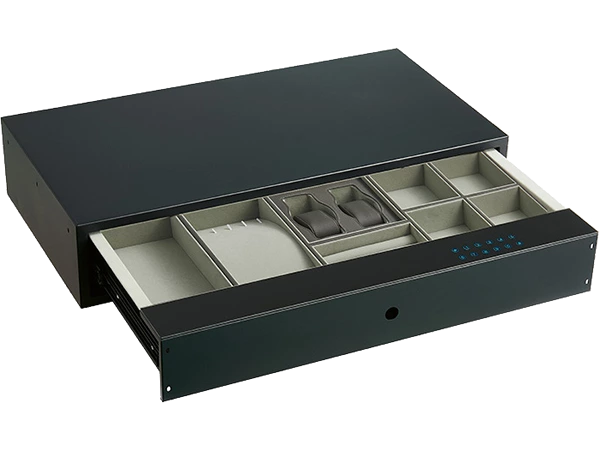
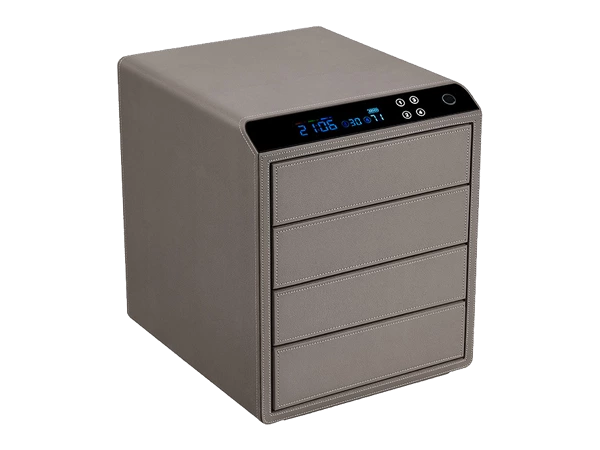
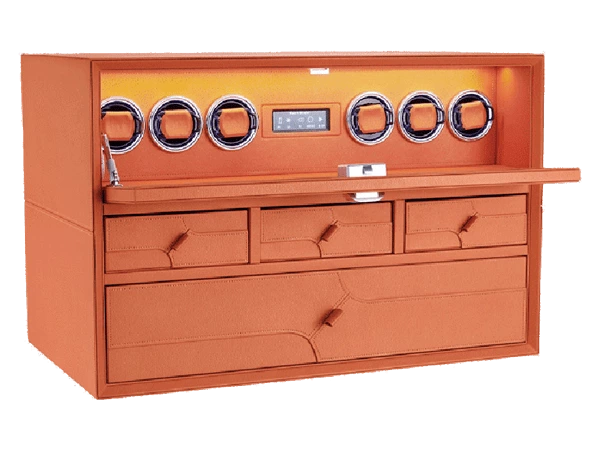
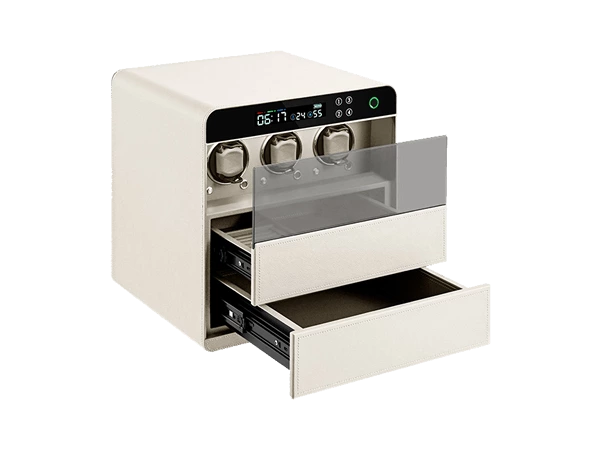
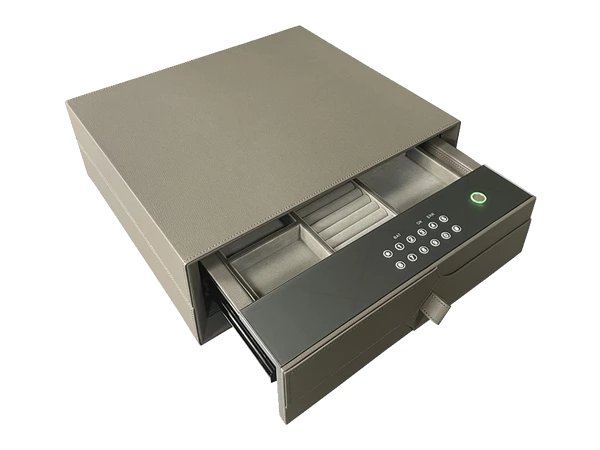
A Canadian safe distributor required a compact smart safe that could address several end-user applications instead of being limited to one installation type. The selected configuration was a fingerprint drawer safe designed for home offices, bedrooms, closets, wardrobes, and other furniture-based storage locations where jewelry, documents, cash, watches, keys, and personal valuables may need controlled access.
The smart drawer safe combines fingerprint and password unlocking with a mechanical backup key. A tempered glass control panel provides touch-sensitive operation, while the cabinet uses thickened steel construction and includes an incorrect-entry alarm. Inside, a hand-finished flannel surface creates a softer storage environment. The electronic system uses a rechargeable lithium battery with Type-C charging.
For a distributor, the important advantage is configurability: size, color, internal layers, and storage-box design can be adjusted according to different customer and furniture requirements.
Project Overview
The Canadian buyer in this case was a safe distributor rather than a single residential customer. That distinction changes how the product needs to be evaluated.
A distributor may supply one drawer safe for a bedroom closet and another version for a home office. Some customers may prioritize jewelry storage, while others need controlled space for passports, documents, cash, keys, or personal electronics.
The core safe therefore needs to remain commercially consistent while allowing enough customization to serve different applications.
| Project Item | Details |
| Market | Canada |
| Client Type | Safe Distributor |
| Applications | Home, Office, Bedroom and Closet |
| Safe Type | Smart Drawer Safe |
| Main Access | Fingerprint recognition |
| Additional Access | Digital password and mechanical key |
| Control Interface | Tempered glass touch-sensitive panel |
| Cabinet Structure | High-strength thickened steel plate / all-steel fabrication |
| Alarm | Error alarm |
| Interior | Hand-finished flannel interior |
| Power | Rechargeable lithium battery |
| Charging | Type-C charging interface |
| Customization | Size, color, multilayer configuration and inner-box design |
| Project Objective | Create a customizable smart drawer-safe platform suitable for jewelry, document, and personal valuables storage across multiple end-user applications |
Understanding the Distributor’s Requirements
For a distributor, the question is not simply whether the lock works. The product has to make sense for several different customer profiles.
A homeowner may want a fingerprint drawer safe positioned inside a bedroom wardrobe for jewelry and personal valuables. A home-office user may prioritize passports, documents, cash, or business-related items. Another customer may need the same basic safe inside a closet or fitted cabinet.
The product therefore needs a balance between consistent core functions and adaptable storage.
Fingerprint recognition, password access, and a mechanical key give the user several ways to operate the safe. The rechargeable battery supports the electronic system, while the flannel-lined interior makes the storage area more suitable for personal items than an unfinished steel compartment.
Customization provides the other half of the solution. Size affects where the safe can be installed. Multilayer storage and the inner-box design affect what can be stored and how efficiently the available internal volume is used.
Project Requirements Tree
Canada Safe Distributor Requirement
│
├── End-Use Flexibility
│ ├── Home
│ ├── Home Office
│ ├── Bedroom
│ └── Closet / Wardrobe
│
├── Smart Access
│ ├── Fingerprint recognition
│ ├── Digital password
│ └── Mechanical backup key
│
├── Electronic Functions
│ ├── Tempered glass touch panel
│ ├── Error alarm
│ └── Rechargeable lithium battery
│
├── Interior Storage
│ ├── Flannel-lined surface
│ ├── Multilayer configuration
│ └── Custom inner-box design
│
└── Distributor Customization
├── Size
├── Color
├── Internal organization
└── Application-specific layout
Why a Standard Open-Compartment Safe Was Not the Best Fit
A conventional safe with one open compartment can work well for basic document or cash storage. The requirement becomes more complex when the product is also expected to handle jewelry and other small valuables.
Jewelry storage benefits from organization.
Rings, bracelets, watches, necklaces, documents, and small accessories do not necessarily need the same compartment dimensions. Placing everything together inside one open safe can use the available volume inefficiently and make frequently used items less convenient to access.
A drawer-based structure makes it possible to organize the interior more deliberately.
The furniture-oriented format also gives distributors more application options. A drawer safe can be considered for closets, wardrobes, cabinets, home-office furniture, and bedroom storage rather than requiring a dedicated freestanding position.
For Canadian buyers who want a safe to work with existing furniture, this can be more practical than simply selecting a larger external cabinet.
The product’s electronic functions add convenience, but they should not be confused with a certified security classification. No verified burglary, fire, or insurance rating has been supplied for this case.
The Fingerprint Drawer Safe Configuration
For this distributor project, the product is built around an electronic smart-access platform.
The front control area uses a tempered glass interface with touch-sensitive operation. Fingerprint recognition provides the primary biometric access method.
A digital password is also available.
The mechanical key functions as backup access when electronic operation cannot be used.
This separation is important. Fingerprint and password access are normal electronic functions; the mechanical key provides an alternative physical route rather than another smart feature.
The safe also incorporates an error alarm.
The supplied information confirms the existence of the alarm but does not specify the exact number of incorrect attempts required to trigger it, its duration, whether access is temporarily locked, or how it resets.
The cabinet is described as using high-strength thickened steel plate. Because exact thickness and certified resistance test results have not been supplied, the website should describe the construction without turning it into an unsupported burglary-resistance rating.
Key Safe Configuration
| Configuration | Project Specification | Why It Was Selected |
| Safe Type | Smart drawer safe | Suitable for furniture-based storage applications |
| Primary Access | Fingerprint recognition | Provides convenient biometric access |
| Secondary Access | Digital password | Provides another electronic access method |
| Backup Access | Mechanical key | Provides physical emergency access |
| Control Interface | Tempered glass touch panel | Creates a clean, touch-sensitive operating surface |
| Cabinet Structure | Thickened all-steel construction | Forms the structural body of the safe |
| Alarm | Incorrect-entry / error alarm | Adds an electronic warning response |
| Interior | Hand-finished flannel lining | Provides a softer contact surface for valuables |
| Battery | Rechargeable lithium battery | Supports rechargeable electronic operation |
| Charging | Type-C interface | Provides a familiar charging connection |
| Custom Size | Available | Allows adaptation to different furniture environments |
| Internal Layout | Multilayer and custom inner-box design | Supports jewelry, documents, and other storage requirements |
Jewelry and Personal Valuables Storage
The Canadian case is especially relevant to buyers looking for a safe that can handle both general valuables and jewelry.
Jewelry is different from documents or cash because it often consists of many smaller items. Storage quality therefore depends not only on internal volume but also on how that volume is divided.
The hand-finished flannel interior creates a softer contact surface around stored items. It also improves the visual presentation of the safe when opened.
Multilayer customization can divide the safe into separate storage levels.
A customer may want one area for jewelry, another for watches, and a deeper section for documents or larger valuables. A home-office configuration may use the available space differently.
The exact jewelry compartments used in this Canadian distributor project have not been supplied.
Until those details are confirmed, the article should state only that the inner-box design and multilayer structure are customizable.
Why Fingerprint Access Works Well for Frequently Used Storage
A safe inside a bedroom, closet, or home office may be accessed more frequently than a larger safe used primarily for long-term document storage.
Fingerprint recognition is useful in that context because it reduces the need to enter a password during every normal access cycle.
The digital password remains available as an alternative electronic method.
The mechanical key provides backup access when needed.
For a distributor, these methods should be described clearly because they solve different user requirements. They should not all be grouped together as vague “advanced security technology.”
The fingerprint reader addresses identity-based access. The password provides code-based access. The mechanical key provides physical backup.
This kind of precise terminology improves product understanding for B2B buyers and helps avoid overstating security performance.
Rechargeable Battery and Type-C Charging
The electronic system uses a rechargeable lithium battery with a Type-C charging interface.
For a smart safe, rechargeable power can simplify routine maintenance because the user does not have to rely entirely on regular disposable-battery replacement.
Type-C also provides a familiar physical charging connection.
However, the available project information does not include battery capacity, charging voltage, charging duration, standby period, number of opening cycles, or battery life.
These values should not be estimated for marketing purposes.
If those specifications become available later, they would be useful additions to the corresponding product page because distributors often need clear electrical information for catalogues and customer support.
Customization for the Canadian Distributor
The confirmed customization scope includes size, color, multilayer configuration, and inner-box design.
For a distributor, these options allow one core smart-safe platform to serve several market segments.
Custom Size
Different furniture installations have different dimensional limits.
A drawer safe for a bedroom wardrobe may require a shallower configuration than one placed inside office furniture. Custom sizing allows the safe to be evaluated against the actual installation environment.
Exact project dimensions have not been supplied.
Custom Color
Color customization allows visible areas of the safe to coordinate with different furniture systems or distributor product ranges.
No specific project color has been supplied.
Multilayer Storage
Dividing the internal height into several levels can improve organization without necessarily increasing the external cabinet size.
Jewelry-focused layouts may benefit from several shallower storage levels, while office applications may require deeper compartments.
Inner-Box Design
The inner box determines how the available space is divided within each layer.
Different layouts can therefore be developed for jewelry, watches, documents, keys, cash, accessories, and other personal valuables.
Customization Structure
Fingerprint Drawer Safe
│
├── External Configuration
│ ├── Custom dimensions
│ └── Custom color
│
├── Internal Architecture
│ ├── Number of storage layers
│ └── Layer depth allocation
│
├── Inner Organization
│ └── Custom storage-box layout
│
└── Market Application
├── Jewelry storage
├── Home office
├── Bedroom
└── Closet / Wardrobe
Manufacturing and Quality Considerations
A fingerprint drawer safe combines several manufacturing systems inside one cabinet: steel fabrication, electronic access, drawer movement, interior finishing, battery power, and control-panel installation.
The steel cabinet provides the structural foundation.
When custom dimensions are involved, dimensional accuracy becomes especially important because a furniture-integrated safe may have to fit inside a predefined cabinet opening.
The drawer mechanism also needs to operate without interfering with the internal storage sections or electronic components.
The tempered glass interface, fingerprint module, password system, alarm, rechargeable battery, and charging connection must be integrated into the cabinet while remaining accessible for normal use and maintenance.
Interior workmanship is also visible to the end user. Flannel surfaces, seams, corners, storage boxes, and compartment alignment affect the perceived quality of the product every time the safe is opened.
Before packing, the control interface and visible surfaces should receive appropriate protection against scratching and handling damage.
No verified inspection frequency, fingerprint-cycle test, alarm test, battery endurance test, steel thickness, drop test, burglary rating, or fire-resistance result has been supplied for this case.
Such information should only be published when supported by actual technical or manufacturing records.
From Distributor Requirement to Product Configuration
Based on the confirmed project information, the specification process can currently be represented as follows:
Canada Safe Distributor
↓
Target Applications Defined
↓
Home + Office + Bedroom + Closet
↓
Fingerprint Drawer Safe Selected
↓
Access System Defined
↓
Fingerprint + Password + Mechanical Key
↓
Electronic Configuration
↓
Touch Panel + Alarm + Rechargeable Battery
↓
Interior Requirement
↓
Flannel Finish + Custom Storage
↓
Customization Scope
↓
Size + Color + Multilayer + Inner Box
↓
[FACT NEEDED: Sample / Drawing Confirmation]
↓
[FACT NEEDED: Production and Inspection]
↓
[FACT NEEDED: Distributor Delivery / Market Launch]
If genuine technical drawings, sample-development photographs, factory production images, inspection records, or distributor packaging photographs are available, these should be incorporated into the case.
For B2B buyers, evidence of how the configuration was developed is more useful than generic promotional statements.
The Final Product Configuration
Based on the information supplied, the Canadian distributor project resulted in a smart drawer-safe configuration centered on three areas: flexible access, organized valuables storage, and customization for multiple end-use environments.
Fingerprint recognition provides the primary biometric access method. The password system provides another electronic option, while the mechanical key acts as physical backup.
The tempered glass panel creates a clean operating interface, and the error alarm provides an additional electronic warning function.
The rechargeable lithium battery and Type-C interface support ongoing electronic operation.
Inside, the hand-finished flannel surface makes the product more appropriate for jewelry and personal valuables than an unfinished metal compartment. Multilayer and inner-box customization provide flexibility for different customers.
What has not been provided is a verified commercial result.
Until then, the case should focus on confirmed product configuration and sourcing considerations rather than implying sales success.
What Buyers Can Learn From This Case
For distributors, the first priority should be application flexibility. A smart drawer safe intended for several customer groups needs to retain a consistent basic structure while allowing dimensions and interior organization to change.
Second, jewelry storage should be evaluated by usable organization rather than total volume alone. Smaller divided compartments may be more valuable than one larger empty space when the primary items are jewelry and watches.
Third, access features should be specified individually. Fingerprint access, passwords, mechanical backup, alarms, and battery systems perform different functions. Precise technical descriptions are more useful than broad “smart security” language.
Fourth, furniture integration requires dimensional planning. Overall width, depth, height, drawer movement, control-panel access, and charging access should all be considered when the safe is intended for a closet, wardrobe, or cabinet.
Finally, distributors should request documentation for any claimed security classification. Thickened steel construction and electronic locking are valid product features, but they do not by themselves establish a certified burglary, fire, or insurance rating.
Frequently Asked Questions
Can a fingerprint drawer safe be used for jewelry storage?
Yes. A fingerprint drawer safe can be configured for jewelry storage when the interior layout is designed around smaller valuables. This product supports multilayer storage and customized inner-box design, allowing different areas to be planned for jewelry, watches, documents, or other items. The exact compartment arrangement depends on the internal dimensions and confirmed buyer requirements.
Is this smart drawer safe suitable for a home office?
The supplied application scope includes home and office use. A drawer safe can provide controlled storage for documents, cash, keys, jewelry, and other personal or business valuables inside suitable furniture. Buyers should confirm available cabinet dimensions and the level of security required for the application before finalizing the product configuration.
What unlocking methods are available?
The specified configuration includes fingerprint recognition, a digital password, and a mechanical key. Fingerprint recognition provides biometric access for routine use. The password gives another electronic option, while the mechanical key serves as physical backup. These functions improve access flexibility but do not represent a specific certified security grade.
Does the fingerprint drawer safe have rechargeable power?
Yes. The supplied configuration uses a rechargeable lithium battery and Type-C charging interface. Exact battery capacity, charging time, standby duration, and operating-cycle data have not been provided. Those figures should be confirmed using technical documentation before they are included in commercial product specifications.
Can the dimensions and interior storage be customized?
Yes. Size, color, multilayer configuration, and inner-box design are included in the available customization scope. For furniture applications, buyers should provide the available width, depth, and height as well as the intended storage items. This makes it possible to evaluate the cabinet dimensions and internal organization together.
What should a Canadian distributor provide before requesting an OEM configuration?
Useful starting information includes the target customer group, intended applications, preferred dimensions, exterior colors, access requirements, internal storage categories, and expected configuration range. If the product will be marketed for closets or furniture integration, installation dimensions and required clearances should also be provided. Final technical specifications should be confirmed before production.
Planning a Similar Smart Safe Program?
For safe distributors, furniture manufacturers, importers, interior project buyers, and OEM/ODM customers, the most useful starting point is to define how the safe will be used.
Provide the target application, cabinet dimensions, preferred unlocking methods, intended stored items, desired finish, and internal organization requirements. For jewelry-focused configurations, information about the types of valuables and required compartment arrangement is particularly useful.
From there, size, color, multilayer configuration, and inner-box design can be evaluated while keeping the fingerprint access and smart drawer platform consistent across different end markets.