How We Helped a Bahrain Client Choose the Right Luxury Safe Size for Jewelry and Watches
When a high-net-worth individual begins to amass a collection of fine watches, rare gems, and priceless family heirlooms, there comes a critical turning point. The realization sets in that a standard, commercially produced metal lockbox tucked away in a closet is no longer sufficient. This is exactly the situation our recent client from Bahrain found himself in.
Residing in a stunning, newly built estate in Manama, he had curated a world-class collection of horological masterpieces and custom-commissioned jewelry pieces. However, as his collection grew, so did his anxiety about its security, preservation, and organization. He reached out to us with a clear but complex mandate: he needed a luxury jewelry safe that offered uncompromised maximum security, perfectly matched his home's modern aesthetic, and, most importantly, was sized correctly to house both his current collection and his future acquisitions.
Choosing the right safe is rarely a straightforward task. It is a meticulous process of balancing physical space, security ratings, environmental controls, and bespoke design. In this comprehensive guide, we will walk you through the exact process we used to help our Bahrain client design and select his perfect vault. Whether you are an avid collector or simply looking to protect your family's most cherished assets, these insights will help you navigate the sophisticated world of high-end asset protection.
The Initial Consultation: Understanding the Scope of the Collection
The first step in any custom safe commission is a deep dive into what exactly is going inside it. When our client initially contacted us, he believed he needed a "medium-sized" safe. However, in our experience, clients consistently underestimate the amount of space their valuables truly require.
During our initial video consultation, we cataloged the items requiring protection. The inventory included:
- Over twenty luxury automatic watches, including highly complicated perpetual calendars.
- His wife’s extensive collection of haute joaillerie, featuring delicate pearls, emeralds, and diamond parures.
- Important family heirlooms, including vintage gold pieces passed down through generations.
- Crucial legal documents, property deeds, and a cache of physical bullion.
A critical factor we immediately had to address was the stringent insurance requirements for high-value private collections. Underwriters for high-net-worth policies do not simply accept any steel box as adequate protection. They require specific, verifiable security ratings based on the total replacement value of the items stored within. If the safe does not meet these criteria, the insurance policy can be voided in the event of a total loss.
Furthermore, our client did not want a utilitarian, industrial-looking gray box marring the beauty of his master suite dressing room. He was essentially looking to create a personalized luxury safe house environment within his own home—a secure ecosystem where the vault itself was as meticulously crafted as the treasures it held. It was time to introduce him to the concept of a true luxury and exclusive safe, customized entirely to his life.

Sizing Up the Safe: Why Bigger is Almost Always Better
One of the most common mistakes collectors make is buying a safe sized only for their current collection. We advised our Bahrain client to apply the "Rule of Double"—calculate the space you need right now, and double it.
Here is exactly how we determined the optimal size for his luxury jewelry safe:
1. Accommodating Integrated Automatic Watch Winder Modules
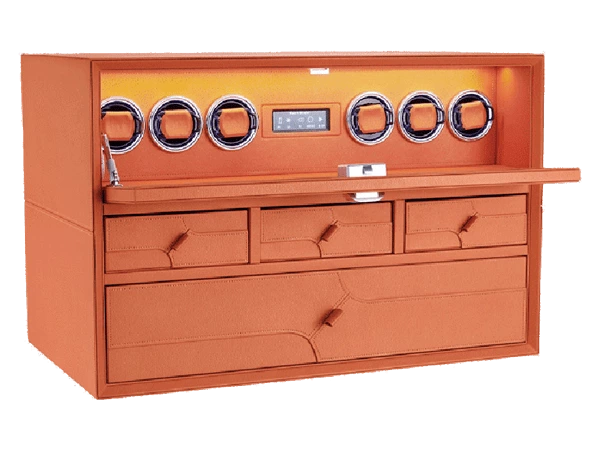
Automatic watches require constant movement to keep their intricate movements lubricated and to avoid the hassle of resetting complex calendar functions every time they are worn. For our client's twenty timepieces, we needed to include integrated automatic watch winder modules.
Watch winders consume a significant amount of vertical and horizontal space inside a safe. Unlike a standard shelf where watches can be laid flat in a compact manner, winders require individual, deeply recessed motorized cylinders. Furthermore, these mechanisms require wiring and spatial clearance to rotate smoothly without watches bumping into one another. We calculated that a panel of twenty winders alone would occupy nearly a third of the internal volume of a standard tall residential safe.
2. Designing Bespoke Velvet-Lined Organizational Drawers
Jewelry cannot simply be stacked or thrown into generic compartments. High-value gems can scratch one another (diamonds, being the hardest mineral, will easily scratch emeralds, sapphires, and gold bands).
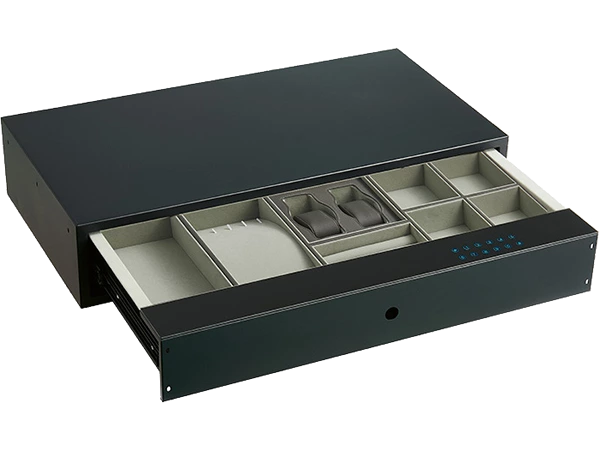
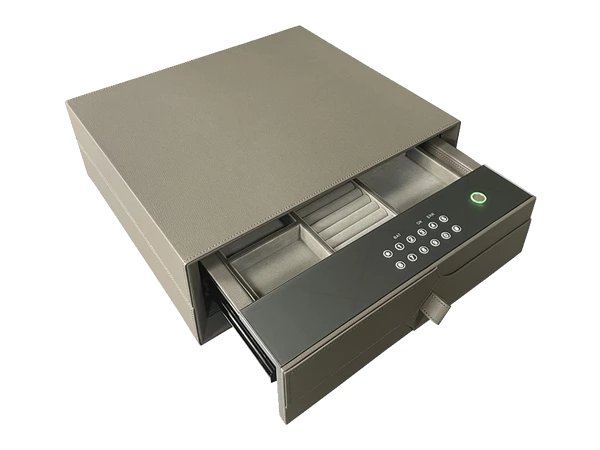
To ensure pristine condition, we collaborated with a top-tier luxury safe factory to design a stack of bespoke velvet-lined organizational drawers. Each drawer was calibrated to specific heights:
- 1.5-inch drawers: For rings, cufflinks, and delicate stud earrings, featuring slotted ring rolls.
- 2.5-inch drawers: Subdivided into geometric compartments for tennis bracelets, brooches, and rigid bangles.
- 4-inch drawers: Designed with custom padded inserts for thick necklaces and statement collars.
By the time we mapped out the watch winders and the custom drawer stack, it became abundantly clear that a "medium" safe would be entirely inadequate. We ultimately selected a towering, double-door model, standing over 65 inches tall, ensuring he would not outgrow his investment within a few years.
Navigating High-Level Security: Burglary Protection Standards
Once the size was finalized, the conversation shifted to physical defense. In the luxury safe industry, aesthetics can never compromise security. Our client wanted absolute peace of mind regarding securing heirloom assets against home invasion and professional burglary attempts.
To explain the different tiers of security, we had to educate the client on Underwriters Laboratories certification standards. Underwriters Laboratories (UL) is an independent safety science company that rigorously tests safes against brutal, real-world attack scenarios using tools ranging from crowbars to acetylene torches.
Why We Chose a TL-30 Rating
For a collection of this magnitude, standard residential security ratings (like RSC - Residential Security Container) were woefully insufficient. We recommended a TL-30 high-security home vault.
But what does TL-30 actually mean?
- TL stands for "Tool Resistant."
- 30 indicates that the safe's door and body can withstand a continuous, sustained physical attack by safecrackers using highly advanced tools (including power saws, heavy-duty drills, carbide chisels, and abrasive cutting wheels) for a net working time of 30 minutes.
It is important to note that "30 minutes" refers to the actual time the tools are making active contact with the safe. In a real-world scenario, factoring in the time required to switch tools, change drill bits, and reposition, a TL-30 safe can easily thwart attackers for hours.
Solid Steel Door Thickness and Boltwork
A TL-30 rating requires immense physical mass. We walked our client through the engineering of his chosen vault. The solid steel door thickness and boltwork were staggering. The door itself contained high-strength alloy steel layered with proprietary advanced composite materials designed to dull drill bits instantly.
The boltwork featured massive 1.5-inch thick solid steel locking bolts that engaged deep into the safe's frame on all four sides. Furthermore, the safe was equipped with sophisticated glass relockers. If a burglar attempted to drill into the lockbox, a tempered glass plate hidden behind the lock would shatter, triggering multiple spring-loaded secondary bolts that permanently lock the safe shut, rendering it practically impenetrable.
Fire Protection: Not All Ratings Are Created Equal
Living in Bahrain, our client was keenly aware of environmental extremes, but a house fire was a universal threat that required meticulous planning. Protecting paper documents is one thing; protecting high-value gems and vintage watches is an entirely different scientific challenge.
We spent a considerable amount of time explaining how to evaluate fire resistance ratings for home vaults. Most commercial fire safes are designed to keep the internal temperature below 350°F (177°C), which is the point at which paper begins to char. However, this temperature is devastating to fine jewelry.
- Pearls and Opals: These organic and water-rich gems will dry out, crack, and discolor at temperatures as low as 150°F.
- Watches: The delicate synthetic oils used to lubricate watch movements will vaporize at higher temperatures, completely ruining the internal mechanisms.
- Precious Metals: While gold melts at a high temperature, exposure to intense heat and the resulting smoke and chemical off-gassing from a fire can cause severe tarnishing and discoloration.
Because he was purchasing one of our high end luxury safes, the vault utilized advanced poured-concrete amalgamate fire shielding rather than standard gypsum board. This provided a verified 2-hour fire rating, ensuring the internal temperature would remain well below the critical danger zones for his most delicate horological and organic pieces.

The Lock Dilemma: High-Tech Convenience vs. Traditional Reliability
With the body of the safe engineered to perfection, we faced the next decision: the lock. A safe is only as secure as its entry point. Our client was torn between modern technology and classic security, bringing up the long-standing debate of biometric vs mechanical dial locks for security.
The Case for Biometric and Electronic Locks
Biometric locks (fingerprint scanners) and electronic keypads offer unparalleled convenience. For a client who wants to access a watch daily before heading to a business meeting, the ability to open the safe in two seconds is highly appealing. Modern biometric scanners are incredibly advanced, using multi-spectral imaging to read the capillary beds under the skin, making them impossible to spoof with fake fingerprints. Furthermore, electronic locks can be programmed with silent duress codes (which alert a security company if the owner is forced to open the safe under threat).
The Case for Mechanical Dial Locks
Mechanical dials are the purist's choice. They require no batteries, no wiring, and have a failure rate approaching zero. They are immune to EMPs (Electromagnetic Pulses) and software glitches. However, they are slow to open and require a steady hand and good lighting.
The Hybrid Solution
Understanding that this luxury safe would be accessed daily, we opted for a high-security redundant lock system. This brilliantly engineered lock features both a commercial-grade electronic keypad and a mechanical dial. The client can use the fast electronic entry 99% of the time, but has the ultimate fallback of the mechanical dial should the electronic components ever fail or the battery die while he is out of the country. This dual-system perfectly satisfied both his desire for rapid access and his need for fail-safe security.

Interior Design: Climate Control and Aesthetic Mastery
A true luxury safe is distinguished not just by its impenetrable exterior, but by an interior that rivals the display cases of top-tier jewelry boutiques in Paris or Geneva.
Environmental Controls
The climate in Bahrain can be incredibly humid, especially during the summer months. Excess humidity is the enemy of fine collections. While gold itself does not rust, the alloys mixed with it can oxidize, and moisture can wreak havoc on leather watch straps and vintage paper documents.
To address protecting precious metal jewelry from environmental damage, we integrated a specialized micro-climate control system within the safe. This included a customized, constantly running dehumidification rod that gently circulated warm, dry air throughout the internal cabin. Additionally, the custom interior design for fine gem storage utilized specialized anti-tarnish micro-suede linings. This fabric is treated to absorb sulfur gases and other airborne impurities that cause silver and lower-karat golds to tarnish, ensuring that every time the client opened a drawer, his wife's jewelry sparkled exactly as it did the day it was purchased.
The Visual Experience
We wanted the client to feel a sense of awe every time he interacted with his collection. The custom luxury safes we commission offer endless aesthetic personalization. For this Bahrain estate, the client selected:
- A high-gloss, hand-polished exterior in a deep, midnight-blue automotive finish, complementing his master suite's decor.
- Interior wood paneling crafted from sustainable Macassar Ebony, featuring a rich, dark grain that contrasted beautifully with the LED lighting.
- Motion-sensor, museum-grade LED downlighting that illuminated the watch winders and the open jewelry drawers without emitting harmful UV rays or excess heat.
The result was not just a security appliance; it was a stunning piece of bespoke furniture.
Strategic Placement and Installation Engineering
The final, and arguably most crucial, phase of the project was figuring out where this massive vault would live and how it would be secured. The most beautiful, highly rated safe in the world is useless if a team of determined thieves can simply wheel it out the front door on a heavy-duty dolly.
Our client asked us a critical question: "What is the safest locati0n for a residential vault?"
Evaluating Placement Strategies
When determining discrete hidden safe placement strategies, we generally advise against the obvious locations like the master bedroom closet, as this is the very first place burglars look. However, convenience is also a factor; if the safe is relegated to a dusty basement, the client will rarely use it, leaving valuables dangerously exposed on nightstands.
For this client, we found a perfect compromise. His home featured a reinforced dressing room with a structural alcove that could be hidden behind a motorized, custom-built mirror panel. This provided immediate daily access for the client while keeping the vault completely invisible to casual guests, domestic staff, or intruders.
The Importance of Anchoring
Because we had selected a massive TL-30 vault, the safe weighed well over 3,000 pounds (approx. 1,360 kg) completely empty. This immense weight alone is a massive deterrent. However, professional thieves are resourceful.
This brought us to the discussion of wall mounted vs floor anchored installations. Wall-mounted safes are generally small, shallow units designed to fit between wall studs. They offer minimal burglary protection and almost no fire resistance. They are fine for a few passports, but wildly inappropriate for high-value collections.
For luxury home safes of this caliber, heavy-duty floor anchoring is mandatory. We worked directly with the client's local structural engineers and contractors in Bahrain prior to the delivery. Because the safe was being placed on a reinforced ground floor, we utilized ultra-heavy-duty expansion bolts drilled directly into the home's concrete foundation slab from inside the safe. Once bolted down, the safe effectively became a structural component of the house itself. It could not be moved, tipped, or extracted without demolishing the building's foundation.
This flawless integration is what truly defines luxury jewelry safes home installations. It marries the robust, unyielding nature of commercial security with the refined elegance of residential architecture.

The Final Result: Delivering Absolute Peace of Mind
Shipping a 3,000-pound highly calibrated instrument of security from a premier manufacturing facility to an estate in the Middle East requires meticulous logistical planning. We coordinated specialized white-glove riggers in Bahrain who possessed the specialized stair-climbing robotics, heavy-duty steel plating (to protect the client's marble floors), and discrete delivery protocols necessary for this caliber of installation.
When the installation was complete and the hidden mirror panel slid away to reveal the midnight-blue vault, our client was speechless. As he began transferring his Patek Philippe and Rolex timepieces onto the rotating winders, and his wife arranged her diamond sets into the velvet-lined drawers, the true value of the safe became apparent.
It was no longer just about meeting insurance mandates or checking boxes for security ratings. It was about the tangible relief that comes from knowing your family's legacy is protected by the pinnacle of modern engineering. Every watch was ticking, perfectly on time. Every gem was shielded from the harsh coastal humidity. The home was fortified against any conceivable threat.
Conclusion: Investing in Your Legacy
Choosing the right safe is an investment that matches the importance of the collection it protects. As our Bahrain client learned, transitioning to a high-end luxury safe requires careful consideration of volume, physical security, environmental protection, and architectural integration.
By prioritizing stringent UL-rated burglary protection, understanding genuine fire ratings, integrating specialized watch winders, and demanding custom interior designs, you are not simply buying a heavy metal box. You are commissioning a bespoke fortress. Whether you are preserving intricate horological wonders, heirloom jewels, or priceless documents, the right luxury safe ensures that your legacy remains secure, pristine, and beautifully displayed for generations to come.